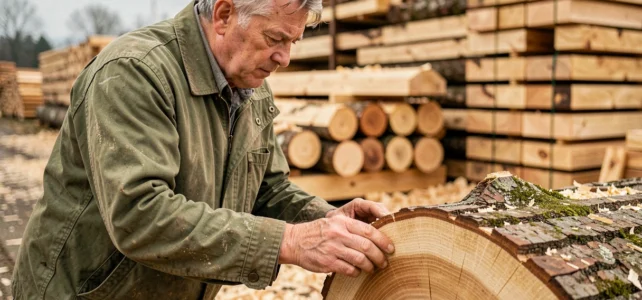
The standing oak shows a median of 136 €/m³ based on the latest ONF sales, compared to 141 €/m³ over the previous twelve months. Talking about new records for wood prices in 2026 is more of a catchy headline than a reflection of market reality. We observe a plateau, or even a slight downturn, which masks very different dynamics depending on the marketing method, region, and diameter of the logs.
Standing oak and sawn oak: two markets, two price perspectives
The most common mistake in public analyses is treating the price of oak as a homogeneous block. The standing market and the roadside sawn market do not follow the same purchasing logic or the same buyers.
Sawn oak reaches a median of 215 €/m³, which is over 60% higher than standing oak. This gap includes the costs of felling, forwarding, and sorting, but it also reflects a different clientele: local sawyers, log traders, and artisan carpenters who buy calibrated lots. Standing oak, on the other hand, remains the playground of forest operators capable of mobilizing their own teams of loggers.
The price dispersion for standing oak remains considerable. A small-diameter coppice intended for firewood has nothing to do with a large-diameter stand oriented towards veneer or sawing.
Comparing these products is like putting table wine and a grand cru in the same basket. Professionals monitoring wood prices in 2026 benefit from reasoning by segment rather than by species.
Oak prices by region: geography weighs more than the economy
The map of regional prices tells a story that national averages obscure. In 2026, the disparities are striking:
- Bourgogne-Franche-Comté: median at 208 €/m³, driven by the concentration of high-quality timber stands and the proximity of major log traders.
- Grand Est: median at 84 €/m³, reflecting a volume mix where small wood and heating have a greater weight in the auctions.
- Nouvelle-Aquitaine: median at 53 €/m³, a level explained by the predominance of maritime pine in the region and often lower-quality oak lots.
The gap between Bourgogne and Nouvelle-Aquitaine exceeds a factor of four. An investor or standing wood buyer reasoning in “national average price” misses the reality on the ground. The location of the plot, forest access, and the proximity of sawmills within an economically viable transport radius determine the price as much as the intrinsic quality of the wood.
Size and destination: the real determinants of price per cubic meter
The diameter of the wood remains the dominant valuation factor. Large-diameter oak lots (intended for sawing or logs) trade at levels incomparable to average wood.
Logs, which are used to make barrel staves, drive prices up in the Burgundy and Centre regions. A straight, knot-free sessile oak with a fine and regular grain can achieve valuations significantly above the national median. Conversely, a lot of coppice under a stand with a diameter of 15 cm will be sold as energy wood at a floor price.
The “energy” standing oak remains very low, confirming that the demand for firewood is not enough to lift the entire market. Forest owners hoping to value small wood plots at the same pace as quality stands face this reality.
Criteria that push a lot to the high end of the range
- Diameter greater than 50 cm, straight butt log of at least 4 meters.
- Absence of visible knots, fine grain (tight rings, typical of slow-growth sites).
- Correct access allowing forwarding without degrading the logs.
- Proximity to a sawmill or specialized trader (logs, sawing) reducing transport costs.
Price plateau for oak in 2026: decline or sustainable stabilization
The drop in the median from 141 to 136 €/m³ in the latest sales may seem anecdotal. However, it signals a change in dynamics. After several years of increases driven by sustainable construction and international demand (export barrels, high-end flooring), the market is now absorbing a rebalancing between supply and demand.
On the supply side, the volumes put up for sale by the ONF remain substantial. On the demand side, the state of new construction in France weighs on the outlets for standard sawing, although premium segments (barrel making, high-end furniture) are holding up better.
The median, higher than the average price observed in large volume transactions, confirms that large lots pull the unit price down. Buyers of large volumes negotiate discounts that smaller lots do not experience. For a private forest owner with a few hectares, the median remains a more reliable indicator than the average.

The scenario of oak hitting new records in 2026 seems unlikely for the standing segment. Market fundamentals point towards stabilization around current levels, with regional variations that will continue to widen the gaps. The real lever for valuation remains forestry patience: allowing trees to grow to access the markets for logs and sawing, where prices have no obvious ceiling.