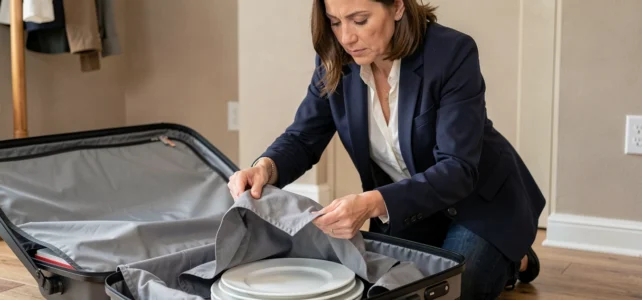
Dishes do not appear on any list of items explicitly prohibited in the cabin with Air France. They are also not listed as explicitly permitted items. The difficulty lies in this regulatory ambiguity, exacerbated by the discretionary power of airport security agents.
Airport security screening: the real blockage for cabin dishes
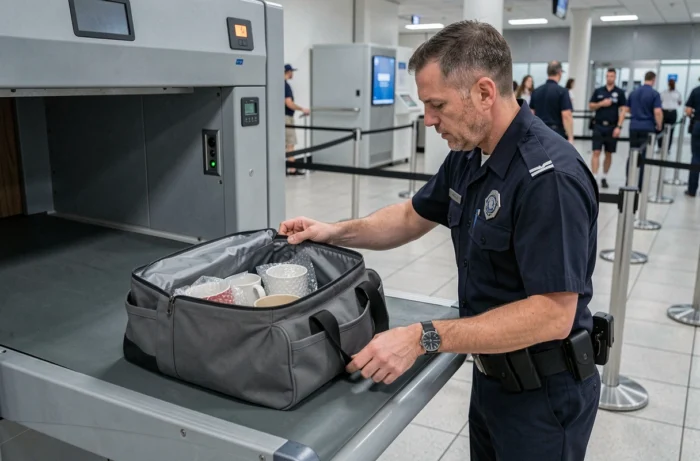
Air France’s regulations refer to the security rules defined by the DGAC and EASA, which are aligned with IATA standards. These rules primarily target sharp objects or items that can be used as weapons. A ceramic plate, a stoneware dish, or a crystal glass are not sharp in themselves, but a security agent may determine that a broken object could produce sharp edges.
This discretionary power is exercised at the screening inspection point (PIF), not at the check-in counter. In practice, a passenger can pass through the Air France counter without difficulty and have their dishes confiscated at the PIF. The opposite never happens: the PIF takes precedence over the airline.
We observe that the risk of refusal significantly increases with certain types of objects. A wooden olive bowl or a melamine plate passes without discussion. A fine porcelain service, a ceramic cheese knife, or a crystal stem glass regularly trigger thorough checks. Before preparing your luggage, the detailed rules on transporting dishes in cabin baggage with Air France help anticipate these situations.
Size and weight constraints: dishes and Air France cabin allowance
Dishes must fit in luggage that complies with the cabin dimensions of 55 x 35 x 25 cm, including handles and wheels. The total weight of the cabin baggage and personal item must not exceed 12 kg in Economy or 18 kg in Business and La Première.
A set of six stoneware plates easily weighs several kilograms. Add the cushioning (bubble wrap, foam) and the weight of the suitcase itself: the 12 kg allowance in Economy is quickly reached. This is a calculation to be made piece by piece, not by guesswork.
If an excess is detected at boarding, Air France redirects the baggage to the hold, charging for an additional bag if the hold allowance is already used. The dishes then find themselves in a much harsher handling environment, with no guarantee against breakage.
Materials and weight: a decision to make before departure
We recommend weighing each piece with a portable luggage scale. A serving dish made of earthenware can represent a significant part of the allowance on its own. Pieces made of wood, bamboo, or melamine offer a much more favorable volume/weight ratio for cabin transport.
Fragile items in the cabin: what Air France covers (and does not cover)
Air France does not formally refuse fragile items in the cabin. However, the airline specifies that fragile items travel at the passenger’s own risk. No compensation is provided for an item broken in the overhead compartment or under the seat.
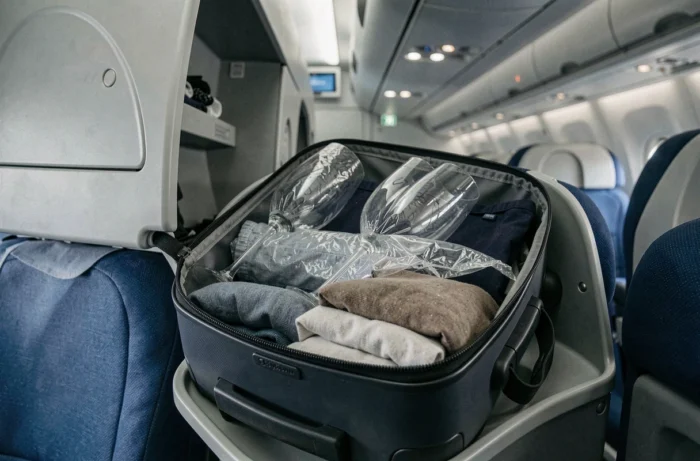
The overhead compartment experiences movements during taxiing, takeoff, and turbulence. An unsecured item in the overhead compartment can slide and break. Storing under the front seat offers more stability, but the space is limited to 40 x 30 x 15 cm (dimensions of the personal item).
- Porcelain, earthenware, stoneware: fragile to shocks, require individual cushioning piece by piece with bubble wrap or foam
- Glass and crystal: high risk of breakage, to be wrapped separately in thick fabric or rolled socks, then secured without dead space in the luggage
- Thick glazed ceramic, wood, melamine: sufficient shock resistance for cabin transport without reinforced cushioning
- Unglazed terracotta: porous and brittle, sensitive to pressure from neighboring luggage in the overhead compartment
Dishes in the Air France hold: when the cabin is not the right option
For bulky sets or heavy pieces, the hold remains the rational choice. Checked baggage supports much larger dimensions and a more generous weight allowance depending on the fare class and Flying Blue status.
Cushioning in the hold must be considerably more robust than in the cabin. Checked baggage undergoes drops, stacking, and continuous vibrations. Each piece of dishware must be individually wrapped, separated from others by at least two layers of cushioning material, and everything must be secured to prevent internal movement.
Products associated with dishes: the liquid rule applies
A often overlooked point concerns products transported with the dishes. Dish soap, a homemade sauce brought back as a souvenir, or a cleaner slipped into the same cabin baggage remain subject to the 100 ml per container rule, in a resealable transparent plastic bag of a maximum of one liter.
This constraint also applies to pastes, gels, and creams. A ceramic jar filled with homemade jam combines two problems: the fragile container and the liquid content subject to the limitation.
Return from travel and customs: artisanal dishes and allowances
Upon returning from a trip outside the European Union, artisanal dishes purchased abroad count towards the customs allowance. Exceeding this allowance incurs customs duties and import VAT.
Items made from protected animal (mother-of-pearl, horn, bone) or protected plant materials may fall under the CITES Convention. Air France explicitly mentions restrictions related to protected animals and plants in its list of regulated products, which includes items made from these materials.
- Exotic wood dishes: check that the species is not listed in the CITES annex before departure
- Items made of mother-of-pearl or horn: subject to declaration and potentially to an export certificate from the country of origin
- Classic ceramics and porcelain: no specific customs restrictions on the material, only the value counts
Transporting dishes in Air France’s cabin remains technically possible for lightweight, non-sharp pieces that are properly cushioned. The determining factor is not the airline’s policy but the decision of the agent at the security checkpoint. Prioritizing durable materials, respecting the weight allowance, and anticipating the PIF check avoids most disappointments.