
A taxi breaks down in the middle of a ride, leaving the passenger stranded on the side of the road. The first question that arises is not mechanical; it is financial: who pays for the rest of the journey? The answer depends on the driver’s status, their insurance contract, and the type of breakdown. Understanding the obligations that apply to stranded taxis helps avoid misunderstandings between the passenger, driver, and insurer.
Securing the stranded taxi: what the driver must do first
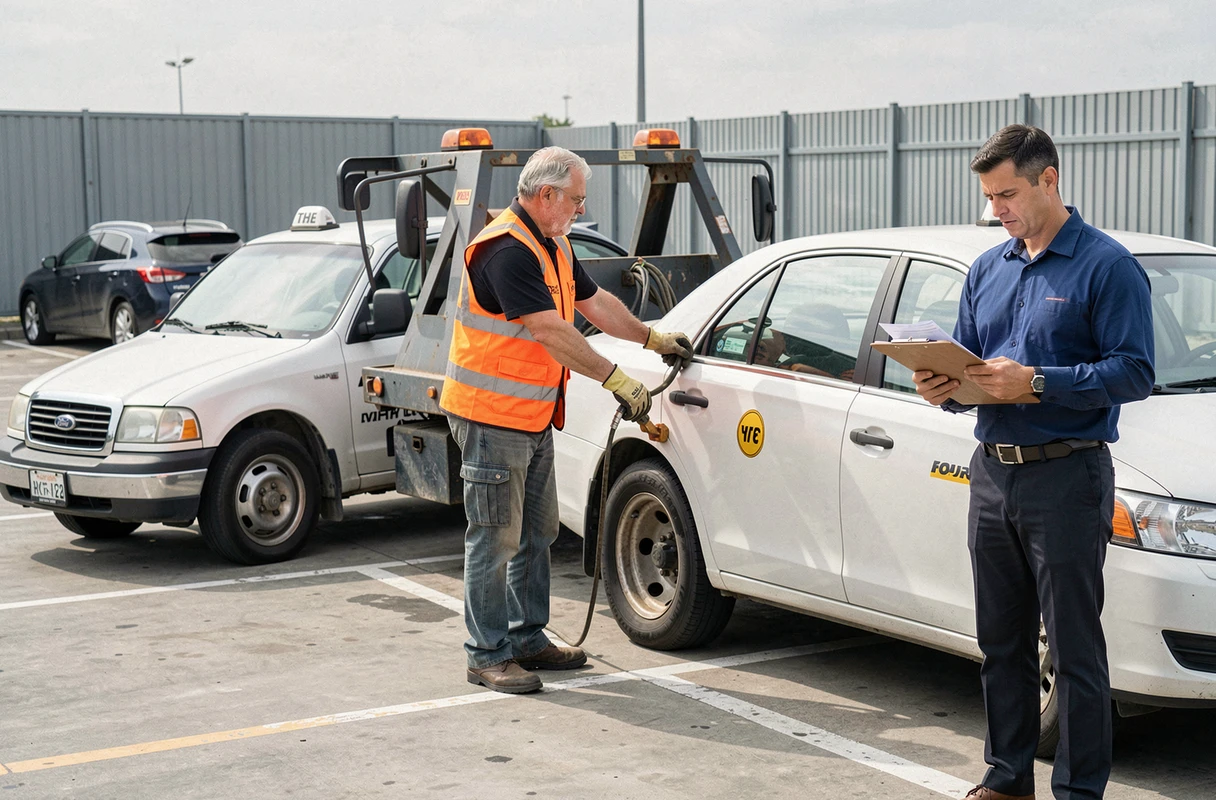
Before discussing reimbursement or financial responsibility, there is a step that many overlook. The driver must secure the vehicle and their passengers immediately. On a highway or fast lane, wearing a reflective vest is mandatory as soon as the vehicle is exited. The taxi must be signaled with hazard lights and, if possible, moved off the roadway.
If the driver refuses to move their vehicle or is absent, a qualified agent may intervene by default. The relocation is then done at the risk and expense of the driver and those civilly responsible. This refers to an additional cost that adds to the breakdown itself, a detail rarely anticipated by independent drivers.
For the passenger, this safety phase does not change anything about the ongoing ride. The meter stops at the moment of the breakdown, not after a prolonged wait on the side of the road. A detailed article discusses the obligations for stranded taxis and the responsibilities of each party.

Taxi insurance and breakdown: who covers the passenger’s transport
The crux of the issue lies in the driver’s insurance contract. A professional taxi must take out insurance suitable for the paid transport of passengers, which goes beyond simple car insurance. This coverage generally includes professional liability for bodily, material, and immaterial damages caused to third parties, including passengers.
Third-party insurance or comprehensive coverage: the concrete difference
With third-party insurance, the driver has limited coverage: professional liability, theft, fire, glass breakage, and legal protection. In the event of a mechanical breakdown, no replacement vehicle guarantee is included in the basic package.
Comprehensive insurance adds additional guarantees, including the provision of a replacement vehicle and sometimes reimbursement of alternative transport costs for passengers. This is where the question of a replacement taxi finds its contractual answer.
- Third-party insurance does not cover the costs of rerouting the passenger in the event of a simple mechanical breakdown
- Comprehensive insurance may include a replacement vehicle and coverage of alternative transport, depending on the guarantees subscribed
- Professional liability covers damages suffered by the passenger (professional delay, missed connection) if the driver’s fault is established
- Some contracts provide for specific assistance with repatriation of passengers, but the conditions vary from one insurer to another
The role of assistance included in the contract
Most professional taxi insurances include an assistance component. In practice, a dedicated number is called, a breakdown service intervenes, and, depending on the contract, passengers are rerouted to their destination. The passenger should never advance costs if assistance is activated.
Feedback varies on this point: some drivers report significant delays before the arrival of the replacement vehicle, which prompts the passenger to take another taxi on their own initiative. In this case, the bill becomes a subject of dispute.
Breakdown during the ride: does the passenger have to pay for the interrupted ride
A ride that stops halfway poses a direct question. Does the passenger have an obligation to pay the amount displayed on the meter at the time of the breakdown?
The principle is simple: the driver has not fulfilled their obligation to transport to the destination. Therefore, the passenger is not required to pay the full amount of the planned ride. The amount due corresponds to the distance actually traveled, but in practice, many drivers choose not to charge for an incomplete ride to preserve the business relationship.
If the driver demands full payment, the passenger can oppose it. The driver’s professional liability specifically covers this type of situation: a service not rendered does not generate a full debt.
Replacement vehicle for taxi: price and access conditions
For the driver, a breakdown means more than just an unhappy passenger. It also represents a loss of income as long as the vehicle is immobilized. The replacement vehicle then becomes a major economic issue.
Taxi insurance contracts offer this guarantee as an option or in comprehensive packages. The price of insurance varies depending on the driver’s profile, the area of operation, and the type of vehicle. A Parisian taxi will not have the same rates as a taxi in a rural area.
What the replacement vehicle guarantee actually covers
- The provision of an equivalent vehicle during the repair period, usually limited to a few days
- The delivery costs of the replacement vehicle to the breakdown location or to the driver’s home
- A mileage or time deductible that may reduce the effective coverage
Without a replacement vehicle guarantee, the driver bears the cost of renting a vehicle to maintain their activity. This expense can represent a significant burden over several days of immobilization.
Disputes between passenger and taxi driver after a breakdown
When the passenger has paid for a second taxi out of pocket, recovering the costs involves making a claim to the driver or their insurer. In practice, it is necessary to keep the receipt from the second taxi and send a written request.
The taxi driver, as a transport professional, cannot refuse to assume the consequences of a breakdown that occurred during a ride. Their professional liability extends to the immaterial damages suffered by the passenger, including additional transport costs incurred to reach the initial destination.
A passenger who finds themselves stranded at night or in an isolated area has even more legitimacy to request full reimbursement for alternative transport. Keeping all receipts remains the most protective reflex in case of prolonged disagreement.
The last point to remember concerns employees of a taxi company. In this case, it is the employing company that bears civil liability, not the driver personally. The passenger’s claim is then directed to the taxi company, which has its own insurance and internal procedures for managing claims.