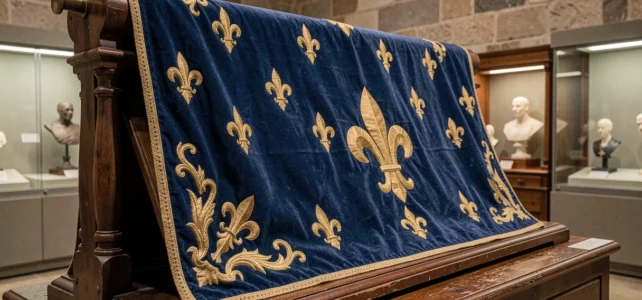
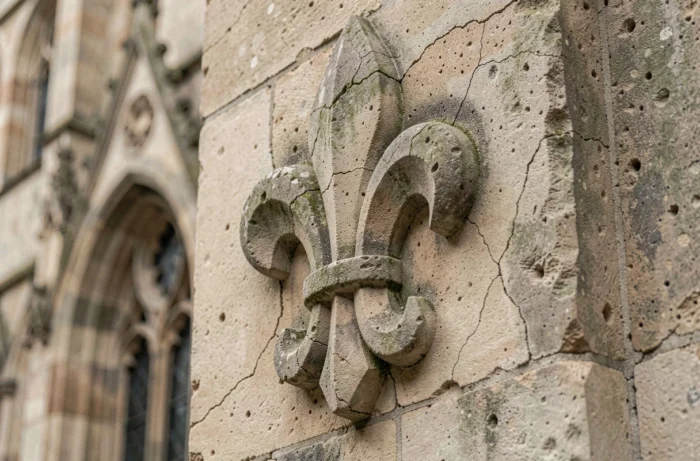
The heraldic fleur-de-lis does not reproduce any existing flower. Its codified design, with its three petals linked by a horizontal band, derives from a graphic convention that solidified on Capetian seals long before it adorned banners. Understanding the flag of the kings of France and the accompanying fleur-de-lis requires distinguishing three layers: the heraldic device, the fabric used in battle, and the state flag, three objects that popular articles consistently confuse.
Heraldry of the semé of lilies: construction and reduction of the royal device
The oldest preserved royal seal featuring the fleur-de-lis is that of Louis VII. The azure field is covered with a semé of golden fleurs-de-lis without a fixed number, a typical arrangement of 12th-century Capetian heraldry. This semé is not limited to the shield: it spreads onto counter-seals, coronation mantles, and liturgical dalmatics.
The reduction to three lilies occurs under Charles V, around 1376. We observe in later armory that this transition from the semé to the three arranged devices (two in chief, one in base) coincides with a desire for readability from a distance and an assumed trinitarian reference. This coat of arms, known as “modern France,” will remain unchanged until the fall of the monarchy.
The fleur-de-lis itself adheres to strict proportions in heraldic description: a lanceolate central petal, two curved lateral petals, and a horizontal fillet. Its shape does not reproduce either the yellow iris of the marshes or the white garden lily, contrary to what popularizations repeat. A detailed article on the flag of the kings of France and the fleur-de-lis on Tous les Faits revisits the botanical hypotheses by confronting them with sigillographic sources.
Royal banner versus state flag: two distinct objects before the Revolution
One point that most articles overlook: the France of the Ancien Régime did not have a national flag in the modern sense. There were several competing fabrics serving different functions.
The war banner, carried into battle, displayed the semé and then the three golden lilies on an azure background. It identified the royal army corps. Next to it often floated the oriflamme of Saint-Denis, a red fabric without lilies, reserved for major engagements and disappeared after the 15th century.
The white flag, on the other hand, gradually established itself on the ships of the royal navy from the 17th century. This plain white, without heraldic device, symbolized the person of the king as sovereign, not the nation. It is this white flag that can be seen in representations of the Battle of Yorktown in 1781, alongside American troops.
- Azure banner with fleurs-de-lis: military identification of the king as commander-in-chief, used from the 12th to the 17th century on battlefields
- Plain white flag: royal navy then army on land under the Bourbons, symbol of personal sovereignty and not of territory
- Oriflamme of Saint-Denis: red fabric entrusted by the abbey, carried before the king during decisive battles, fallen into disuse after Agincourt
- Regimental flags: varied fabrics combining white crosses and colors of the colonel-owner, without strict standardization
This plurality of fabrics explains why it is technically inaccurate to speak of a “flag of France” before 1790. The tricolor is the first French flag to represent the state and not the royal person.
Fleur-de-lis and contemporary recoveries outside France
The fleur-de-lis today exists as an identity marker in territories that have no institutional link to the French monarchy. The most visible case is that of Quebec, whose flag adopted in 1948 features four white lilies on an azure background. The connection to the memory of New France remains explicitly claimed in official speeches.

In New Orleans, the fleur-de-lis transcends its historical context. It adorns the architecture of the French Quarter, urban furniture, and serves as a logo for the NFL team New Orleans Saints. The symbol no longer refers to royalty but to the historical continuity of the French presence in Louisiana.
This phenomenon of detachment between the heraldic device and its original monarchical context is remarkable. In Florence, the city bears a red lily (the giglio) that has never had any link with the Capetians. The motif also circulates in the municipal heraldry of dozens of European cities, from Lille to Wiesbaden, with distinct local meanings.
Fleur-de-lis and the far right: a political hijacking to identify
The fleur-de-lis is today used by some radical royalist movements and by identity groups in France. This hijacking blurs the reading of the symbol in the public space. A tattoo or a fleur-de-lis flag can pertain to historical heritage, regional attachment, or a strongly marked political positioning.
The context of use determines the meaning of the symbol, not the motif itself. Associated with other markers (Celtic cross, references to Charles Martel), the fleur-de-lis signals a precise ideological anchoring. Isolated on a historical building or a municipal coat of arms, it remains a neutral heraldic device.
This ambiguity did not exist under the Ancien Régime, where the fleur-de-lis was a royal monopoly. Its liberation into the public domain after the Revolution allowed for all appropriations, from the most innocuous to the most militant.
The fleur-de-lis motif has traversed nearly nine centuries of uninterrupted use, from the seal of Louis VII to American football jerseys. Its ability to change meaning depending on the territory and the era makes it less a fixed monarchical symbol than a graphic sign whose meaning each community rewrites. It is precisely this plasticity that prevents reducing the fleur-de-lis to a single interpretation.