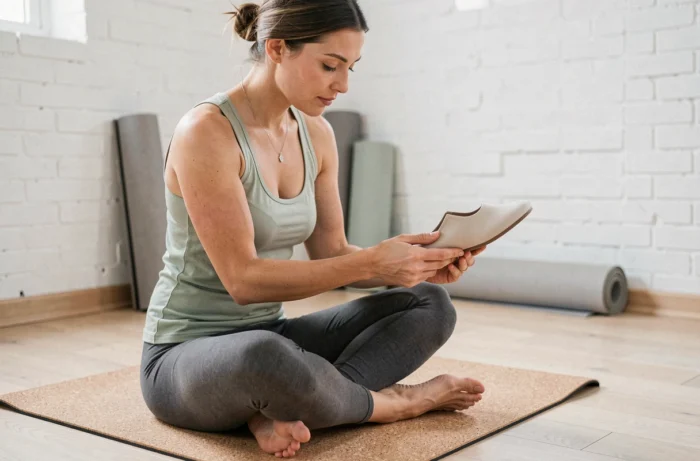
On a cold studio floor at 7 AM, feet slip from the very first greeting to the sun. On a natural rubber mat in a heated living room, the ground connection is immediate, barefoot. These two situations do not call for the same equipment at all, and this is precisely where most generic advice on yoga shoes misses the mark.
Barefoot yoga or with protection: the mat and the floor decide before the shoe
Before looking for a shoe, one should consider what is happening under our feet. Grip primarily depends on the mat-floor combination. A worn mat or a smooth surface (tile, varnished wood) reduces traction much more than a bare foot can compensate for.
In hot yoga, for example, sweat turns the mat into a slippery surface. A non-slip towel placed on the mat improves traction more reliably than a sock or minimalist shoe. It’s a low-cost reflex, often more effective than any accessory worn on the foot.
When practicing in a studio equipped with new mats and a stable floor, barefoot practice remains the reference for proprioception. The foot directly captures variations in pressure, adjusting balance posture by posture. Adding a layer between the foot and the mat filters this signal. This is justified in certain specific cases, not by default.
On the Sportivoz website dedicated to well-being, you can find an overview of situations where wearing shoes makes perfect sense, especially for outdoor practices or on cold surfaces.
Non-slip socks for yoga: what works and what causes problems
Non-slip socks have become the most common option for those who do not want to practice barefoot. They can be seen in Pilates, barre, and gentle yoga studios. Their principle: silicone or rubber dots under the sole that grip the mat.
In practice, not all non-slip socks are created equal. Three criteria separate a reliable model from a gadget that ends up at the bottom of the bag:
- The coverage of the non-slip areas: a grip limited to the forefoot is not enough for postures where the heel bears the weight. Models covering the entire sole offer better stability in lunges and balances.
- The fit of the fabric around the foot: a sock that twists during a sequence creates a fold under the arch, causing discomfort and imbalance. The size must be adjusted, neither too loose nor compressive.
- Compatibility with the session: for slow yoga, yin, or a final relaxation (savasana) in a cool room, socks work well. For fast vinyasa with transitions on the floor, they can reduce the direct sensation of the mat and hinder changes in support.
A often overlooked point: the maintenance of the non-slip surface affects safety. After several washes, the silicone dots lose their grip. You can check by running your finger over them: if the surface has become smooth, it’s time to replace the pair.
Regular socks: a false friend in yoga class
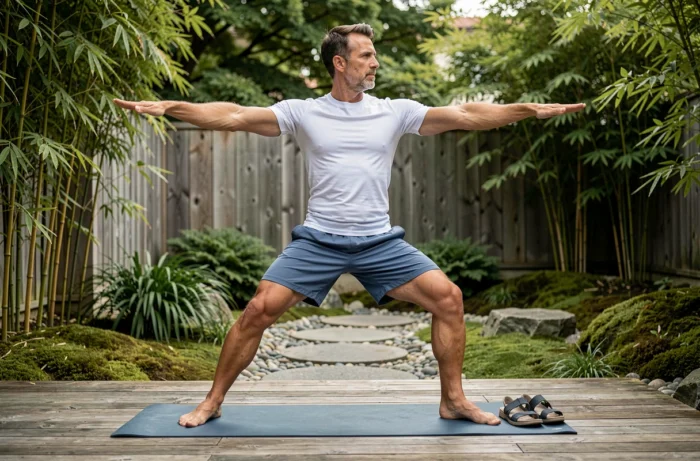
Wearing ordinary sports socks on a yoga mat increases the risk of slipping. Cotton or smooth polyester offers no traction on common mat materials. In standing postures like warrior II or triangle, a slipping foot can strain the knee or hip.
Minimalist yoga shoe: for which type of practitioner
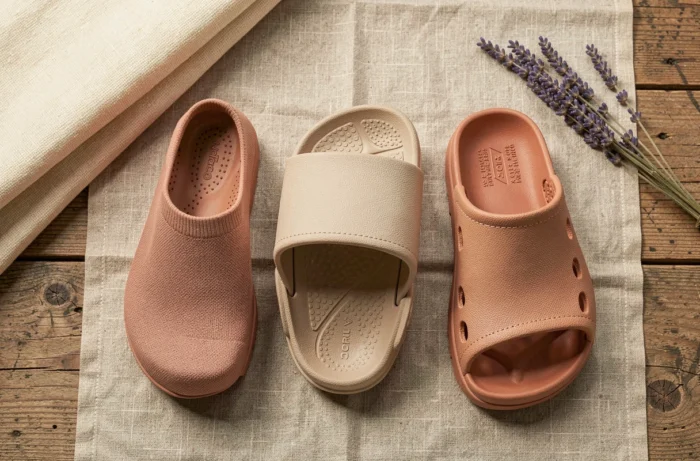
The minimalist shoe is distinguished from a running or fitness shoe by three characteristics: a very thin sole, an almost zero drop (no height difference between heel and forefoot), and the absence of structural reinforcement. The goal is to get as close to the barefoot sensation as possible while protecting the skin.
This type of shoe meets specific situations:
- Outdoor yoga on grass, gravel, or uneven ground, where the sole of the foot needs a physical barrier without losing mobility.
- Studios where regulations require wearing shoes for hygiene reasons.
- Practitioners with skin issues (plantar warts, cracks) that make barefoot practice painful or contraindicated.
The flexibility of the sole is the decisive criterion. One should be able to bend the shoe in half effortlessly. A rigid sole prevents the foot from spreading in grounding postures and disrupts balance. The material should also breathe: a mesh or knit upper wicks moisture better than synthetic leather.
Running or fitness shoes: why they are not suitable for yoga
Running shoes are designed to absorb vertical shocks, with thick cushioning and a pronounced drop. In yoga, this cushioning disconnects the foot from the ground. Balance postures like tree or half-moon become unstable because the foot constantly compensates for the foam under the sole.
A shoe with a drop greater than a few millimeters alters the alignment of postures. The pelvis tilts, the knees compensate, and the spine loses its neutrality. For yoga, we seek the opposite: a flat, stable, connected foot.
Choosing based on the type of session and practice environment
The final choice depends less on a brand or model than on the intersection between the type of yoga practiced and the conditions of the studio or location.
For a hatha or yin session indoors, on a mat in good condition, barefoot remains the most relevant choice. If the floor is cold or if one prefers a layer of protection, non-slip socks with full grip do the job.
For vinyasa or power yoga, feedback varies on this point: some practitioners find that socks hinder quick transitions, while others adapt after a few sessions. The ideal is to test in two or three classes before making a decision.
For outdoor practice or in a shared space (multipurpose room, park), a minimalist shoe with a thin, flexible sole protects without sacrificing proprioception. One simply checks that the sole allows feeling the ground under each toe.
The right footgear for yoga is not universal. It corresponds to the surface under the mat, the temperature of the room, and the pace of the session. Starting by evaluating these three parameters avoids buying an accessory that will end up unused.