
Importing a car from Norway to France requires handling a complete customs file, even though this country shares a space for the free movement of people with the European Union. Norway’s status as a member of the European Economic Area but not the EU creates a gap between perceived fluidity and administrative reality.
This article measures the concrete differences between a classic intra-EU import and an import from Norway, focusing on points where buyers lose time or money.
Intra-EU Import and Import from Norway: Summary of Differences
The difference in treatment between a vehicle purchased in Sweden (an EU member) and a vehicle purchased in Norway (non-EU) lies in several administrative and fiscal aspects. The table below summarizes the main divergences.
| Criteria | Intra-EU Purchase (e.g., Sweden) | Purchase in Norway |
|---|---|---|
| Customs Duties | None | Potentially none if preferential origin is proven; otherwise applicable |
| VAT | Paid in France if the vehicle is new, in the country of purchase if used | French VAT payable in all cases (standard rate) |
| Customs Declaration | Not required | Mandatory (complete customs file) |
| Certificate of Conformity | European COC accepted directly | COC to be verified, isolated reception sometimes necessary |
| Technical Inspection | Foreign EU CT recognized under conditions | Norwegian CT not recognized; new CT in France mandatory |
| Proof of Origin | Not necessary | EUR.1 or declaration of origin on invoice required |
The most underestimated aspect remains proof of origin. Without it, the vehicle is treated as a classic import from a third country, with customs duties calculated on the declared value.
The procedure for importing a Norwegian car therefore involves a significantly heavier file than a purchase in Germany or the Netherlands, even though Norway is geographically and economically close to the EU.

Preferential Origin of the Vehicle: The Trap of Norwegian Electric Cars
Norway has one of the densest electric vehicle fleets in the world. Many French buyers target this market to find recent models at competitive prices. The reasoning seems solid, but it stumbles on a technical point that few listings mention.
A vehicle sold in Norway is not necessarily of Norwegian or European origin. A model manufactured in China and then imported to Norway does not benefit from the EU-Norway preferential agreement. When passing through French customs, this vehicle will be treated as an import from a third country without an agreement, with full customs duties applied.
Check the Origin Before Buying
Proof of origin must be obtained before or at the time of export from Norway. It cannot be reconstructed afterwards. Two documents are accepted by French customs:
- The EUR.1 certificate, issued by Norwegian customs authorities at the time of export, which certifies the preferential origin of the vehicle
- A declaration of origin on invoice, valid under certain value conditions or when the seller has the status of an approved exporter
- In the absence of these documents, a simple purchase invoice mentioning Norway as the country of sale is not sufficient to prove origin
The distinction is crucial for electric cars. A buyer negotiating a good price on a used electric vehicle in Norway may see their financial advantage disappear if the model is not covered by the preferential agreement.
VAT and Registration in France: The Incompressible Steps
The VAT regime applied to a vehicle imported from Norway differs from that of an intra-EU purchase. French VAT is due in all cases, whether the vehicle is new or used. For an intra-EU purchase, VAT on a used vehicle has already been paid in the selling country and is not requested again in France. However, since Norway is a third country for tax purposes, VAT is collected by French customs upon clearance.
Documents Required for Registration
Once the vehicle is cleared, the registration file requires several specific documents:
- The tax clearance certificate issued by the tax office, proving the payment of VAT
- The European certificate of conformity (COC) or, failing that, a report of isolated reception issued by the DREAL
- A French technical inspection less than six months old, as the Norwegian inspection is not recognized in France
- The sworn translation of the Norwegian registration document and any document written in Norwegian
The Norwegian technical inspection is not recognized in France, even if it is recent. The vehicle must undergo an inspection at an approved French center before any request for definitive registration. This point generates an additional delay, as the vehicle must operate with temporary plates or be transported on a flatbed.
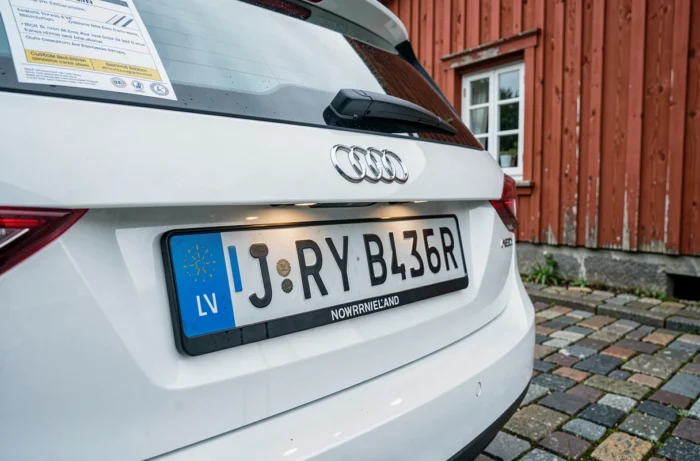
Real Cost of Importing from Norway: Often Overlooked Items
The price displayed on a Norwegian listing does not reflect the final cost for a French buyer. Several items are added to the purchase amount, and their cumulative effect can significantly alter the financial equation.
Sworn translation fees concern the registration document, the local technical inspection, and sometimes the sales certificate. Each translated document represents a unit cost that adds up quickly when the file contains several pieces in Norwegian.
The transport of the vehicle from Norway to France constitutes another variable item. The distance between Oslo and the French border far exceeds that of a repatriation from Germany or Belgium, which impacts the cost of transport or flatbed delivery.
The absence of an EUR.1 certificate can turn a good deal into a neutral operation. If the seller does not provide this document and the preferential origin cannot be proven, customs duties apply in addition to VAT. Requesting this certificate as soon as the commercial negotiation begins remains the most cost-effective reflex throughout the process.
The Norwegian used car market presents real opportunities, particularly for recent electric vehicles and well-maintained high-end models. The trade-off for these attractive prices is a more demanding administrative process than a purchase within the EU, where every missing document can generate additional costs or a blockage. Verifying the vehicle’s origin and securing the EUR.1 certificate before the transaction remains the tipping point between a profitable import and an unpleasant surprise at customs.