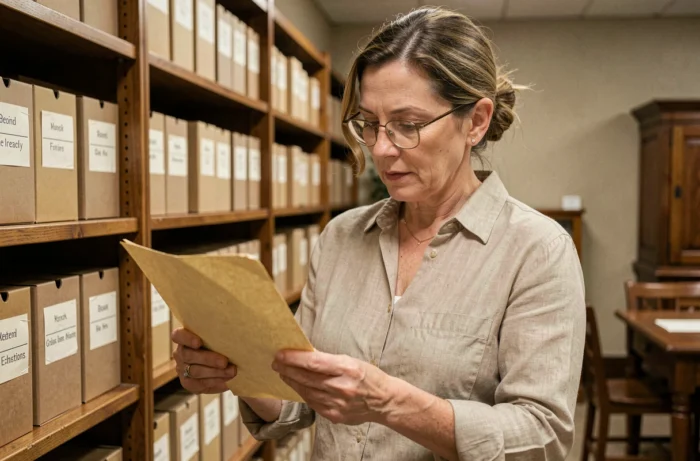
A water damage in a technical room, a poorly prepared server migration, a hard drive that fails unexpectedly: we rarely lose our archives due to willful negligence. Disappearance almost always occurs when no one anticipates it. Preserving our archives, whether paper or digital, relies on concrete actions and technical choices made well before the disaster.
Probative value of digital archives: what cloud storage does not guarantee
Depositing a signed contract in a Google Drive or OneDrive folder does not confer any particular legal value. Confusion is common, and it can be costly during a dispute.
Article 1366 of the Civil Code and the NF Z 42-013 standard set three conditions for a digital document to be enforceable: identification of the author, integrity of the file, and traceable preservation conditions. A simple cloud space, even secured by a password, does not meet these criteria because it does not prove reliable timestamping or the absence of modification since the deposit.
In practice, we distinguish between storage (making a file accessible) and archiving with probative value (ensuring it has not been altered). For a company, professionals specialized in document management and preservation assist with this transition, as can be seen on https://www.lesarchivistes.net, where the professions of archiving are presented in their operational dimension.
A compliant electronic archiving system generates a digital footprint with each deposit, logs access, and prevents any silent modification. Without this system, a digital document remains just another file, not a proof.
Cybersecurity and preservation: versioning as a safety net
Since the increase in ransomware attacks, archiving and IT security can no longer be treated separately. A malicious encryption affecting the file server also destroys the archives if they are stored in the same location, within the same network perimeter.
Automatic versioning is a concrete safeguard. The principle: each modification of a document creates a timestamped copy of the previous version. If a file is encrypted or corrupted, the most recent previous version is restored.
Current recommendations suggest a retention period of at least 30 days for current documents, and ideally 90 days for critical documents (contracts, accounting records, personnel files). Feedback on this point varies depending on the size of the organization and the volume of data, but the principle remains the same: without a version history preserved outside the main perimeter, an attack can render years of archives unrecoverable.
Three measures to implement without delay
- Activate versioning on the document management system with a retention period suited to legal preservation obligations
- Isolate archive backups on a network or medium physically distinct from the production system (principle of air gap or network segmentation)
- Test restoration at least once every six months, because an unverified backup is worthless when needed
Reversibility of the archiving service provider: the trap of dependency
When entrusting archives to an external provider (software publisher, third-party archiver, specialized host), one rarely thinks about the moment when a change will be necessary. The question of reversibility arises as soon as the contract is signed, not at the time of termination.
A digital archiving contract must specify several points that often get overlooked:
- Available export formats: archives must be recoverable in an open and documented format, not in a proprietary format readable only by the provider’s software
- Recoverable metadata: a file without its metadata (deposit date, author, classification) loses a significant part of its archival utility
- Restitution timelines and exit costs: some providers charge for data recovery or impose timelines that make migration impractical in an emergency
Without a clear reversibility clause, one finds oneself trapped in a system. And if the provider ceases operations or changes its pricing, the archives become inaccessible or their recovery costs more than reconstruction.
Classification and retention period: organize before storing
You cannot keep everything indefinitely, nor should you destroy too quickly. The administrative utility duration (DUA) sets, for each type of document, the time during which it must remain accessible. A payslip, a supplier invoice, and a building permit do not have the same DUA.
The management table is the central tool for this organization. It lists each document category, its mandatory retention period, and the final fate (destruction, transfer to permanent archives, sorting). Without this table, classification relies on individual memory, which does not withstand retirement or departmental reorganization.
Digitization and sustainable format
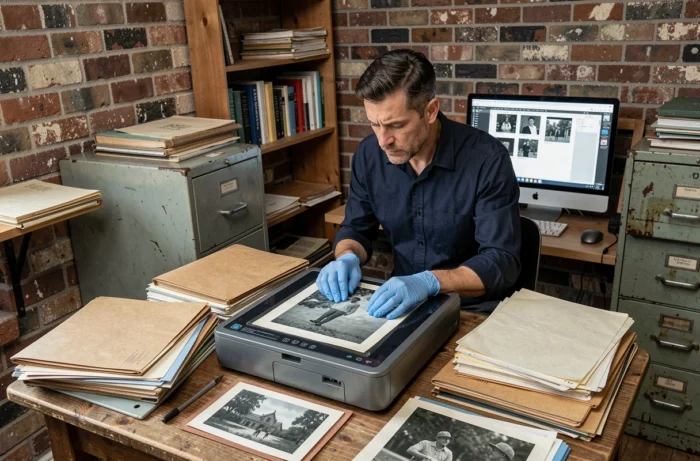
Digitizing paper archives is pointless if the chosen format becomes unreadable in ten years. Open and standardized formats (PDF/A for textual documents, TIFF for images) offer better guarantees of long-term readability than proprietary formats. The challenge is not just to scan, but to produce a digital file that will remain usable without relying on specific software.
Digitization also involves documenting the process: resolution used, digitization date, correspondence with the original paper document. This traceability enhances the intelligibility and authenticity of the digital archive, two criteria on which its long-term value rests.
Preserving archives, whether they fit in a box or on a server, relies on decisions made upstream: the right format, the right contract, the right level of security. The loss of archives always costs more than their organization, and this organization begins with an up-to-date management table and a preservation system whose exit conditions are understood.