
The Puppy Safe anti-bark collar is one of the most visible devices on the French market for dog training accessories. Marketed as an alternative to electric shock collars, it relies on a system of vibrations and sounds to reduce barking. The brand claims a pain-free approach, fast delivery from France, and a satisfaction or money-back guarantee.
In light of the increasing number of online reviews, a factual examination of the product, its limitations, and the context in which it operates allows for a clearer understanding.
Vibration and sound technology: what the Puppy Safe collar actually detects
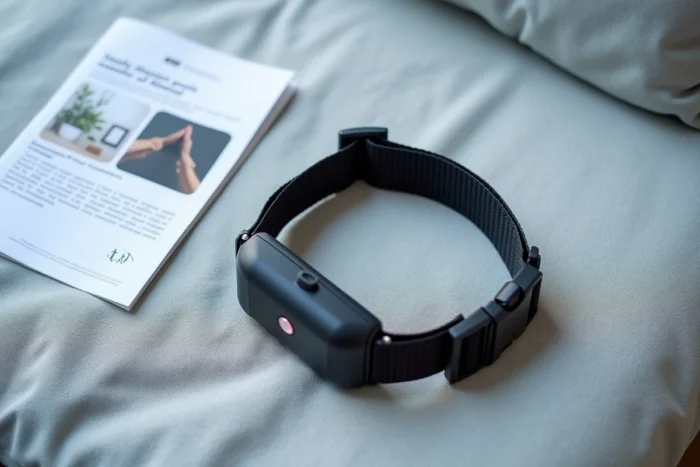
The Puppy Safe collar works thanks to a sensor that reacts to the vibrations of the dog’s vocal cords. When barking is detected, the device first emits a sound signal, then a progressive vibration if the barking persists.
This approach differs from electrostatic impulse collars, but it shares a common limitation with most automatic devices: the sensor does not distinguish the cause of the barking. A dog barking out of fear, excitement, or alertness receives the same mechanical response.
Field feedback confirms this nuance. On a forum of 60 Millions de consommateurs, a user reports that the collar effectively reduced reflexive barking (passing strangers, sudden noise), but not barking related to play excitement. Dog trainers describe the same phenomenon: a collar masks the symptom without addressing the cause (boredom, anxiety, lack of physical activity).
Browsing the reviews of the Puppy Safe anti-bark collar available online, this recurring observation is noted: partial effectiveness depending on the dog’s behavioral profile.

User reviews of Puppy Safe: what independent platforms reveal
Positive reviews often mention fast delivery, the absence of electric shock, and a notable reduction in barking from the first days. Negative reviews, fewer in number but present, point out situations where the collar activates without barking (false positives related to head movements) or a loss of effectiveness after a few weeks, as the dog becomes accustomed to the vibrations.
On Facebook groups dedicated to specific breeds, feedback varies according to the size and temperament of the dog. Owners of small dogs sometimes report a collar that is too heavy or poorly fitted. The available data does not allow for a conclusion on an overall effectiveness rate, as each dog reacts differently to this type of stimulus.
After-sales service: a frequently mentioned point
Several testimonials mention a responsive customer service. One user on the 60 Millions forum received a free replacement for a defective charger, with a turnaround time of about ten days. The brand also offers a “0 barking or money back” guarantee, the exact conditions of which remain to be verified on a case-by-case basis.
Anti-bark collar and dog training: the limitations not mentioned in the product sheet
Professional dog trainers emphasize a fundamental point: a barking dog expresses a need or discomfort. Barking can signal separation anxiety, lack of stimulation, a fear response, or simply a natural alert behavior.
The use of an anti-bark collar, even if pain-free, does not replace foundational work on the dog’s environment. A site specializing in canine behavior describes specific criteria for responsible use:
- The collar should only be used after identifying the cause of the barking by a professional or through the owner’s systematic observation
- It should not be worn continuously, but only in targeted and temporary situations
- It should be paired with positive reinforcement (rewards when the dog remains calm) to establish a lasting behavior
Using a collar alone, without parallel educational work, risks shifting the problem rather than solving it. A dog that can no longer express its frustration through barking may develop other undesirable behaviors: destruction, compulsive licking, or lethargy.
Puppy Safe compared to alternatives: vibration, ultrasound, and positive training
The market for anti-bark collars is divided into three main categories: electric impulse collars (increasingly contested), vibration and sound collars like the Puppy Safe, and ultrasonic devices placed in the dog’s environment.
Vibration collars represent a compromise between automatic intervention and absence of pain. They are better suited for reflexive barking than for barking related to deep behavioral issues.
Ultrasonic devices (wall-mounted or portable) work differently: they emit an unpleasant sound for the dog without physical contact. Their range is limited, and their effectiveness depends on the animal’s hearing sensitivity.
The current trend in dog training leans towards technology-assisted approaches, where the collar is more about detecting signals of stress or excitement and suggesting appropriate exercises via an app, rather than suppressing behavior in an aversive manner. The Puppy Safe, in its current version, remains a classic reactive tool.
- For occasional reflexive barking: the vibration collar can significantly reduce frequency
- For barking related to anxiety or boredom: behavioral work is essential, with or without a collar
- For very sensitive or small dogs: check the weight and fit of the collar before purchase
The Puppy Safe collar functions as a supplementary tool, not as a standalone educational solution. The most positive user feedback consistently comes from owners who have combined it with adjustments in the dog’s daily routine. Those who rely solely on the collar describe a temporary improvement followed by a gradual return of barking.