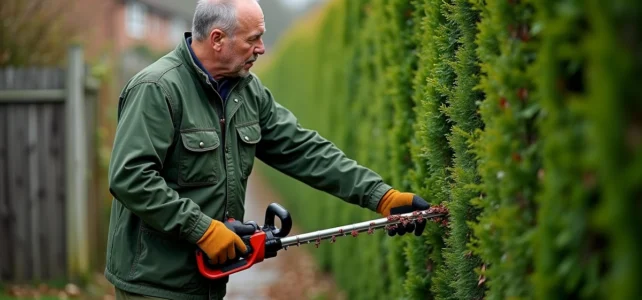
A telescopic hedge trimmer is rarely chosen based solely on the promise of reaching three meters in height. Recent field feedback shows that the main difficulty lies elsewhere: maintaining balance during a prolonged session, ensuring adequate autonomy in a dense hedge, and safely storing the lithium-ion battery between uses. These three parameters, more than the advertised cutting height, separate a successful purchase from a tool relegated to the back of the garage.
Balance and Muscle Fatigue of a Pole Hedge Trimmer
The telescopic pole extends the lever arm. Every additional centimeter of extension amplifies the torque that your shoulders and forearms must compensate for. A model advertised as lightweight can become cumbersome if the battery is attached at the end of the handle or if the mass distribution favors the cutting head.
User feedback in 2026 converges on this point: overall balance matters more than the displayed gross weight. A device weighing a few kilograms with well-distributed weight is easier to handle for longer than a lighter model with a center of gravity shifted forward.
Several factors directly influence this sense of balance:
- The position of the battery on the tool’s body (base of the pole or backpack) radically changes the height balance.
- The presence of a rotating handle or shoulder harness allows for redistributing effort across the torso rather than just the arms.
- The actual length of the pole used: extending the pole to the maximum when the hedge does not require it unnecessarily increases the leverage.
To compare models on this criterion, detailed sheets are available on taille-haie-telescopique.com, with dimensions and weight including the battery for each reference.
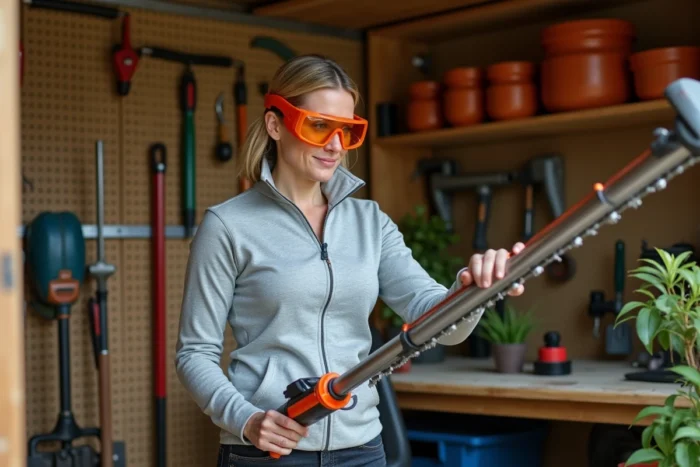
Real Autonomy in Dense Cutting: Comparative Table by Power Type
The autonomy displayed by manufacturers almost always corresponds to cutting soft branches at moderate speed. As soon as the hedge becomes denser (laurel, old thuja, thick privet), the blade demands more from the motor and real autonomy drops significantly.
| Power Type | Autonomy in Soft Cutting | Autonomy in Dense Cutting | Main Constraint |
|---|---|---|---|
| Lithium-ion Battery (Pole) | Acceptable for an average garden | Reduced, sometimes by half | Recharge time between sessions |
| Wired Electric (Pole) | Unlimited | Unlimited | Range limited by the extension cord |
| Thermal (Pole) | Long | Good, more powerful motor | Weight, noise, engine maintenance |
In practice, a battery model is suitable for a hedge of modest length and reasonable thickness. For an old and dense hedge, thermal or wired remains more enduring. The choice also depends on the cutting speed adopted: working slowly while letting the blade do its job preserves the battery much better than a quick pass while forcing.
Double Action Blade and Tooth Spacing
The cutting capacity is not limited to motor power. A double action blade (both blades slide simultaneously) reduces vibrations and requires less energy per branch cut. The spacing of the teeth determines the maximum diameter of the branches that the tool can shear cleanly.
A spacing greater than 16 mm is recommended for persistent hedges with hard wood. Below this, the blade gets stuck on thick branches, which accelerates wear and drains the battery faster.
Rotatable Head: An Often Underestimated Criterion for Tall Hedges
Classic buying guides mention the rotatable head as a bonus. Recent usage tests describe it more as a major practical criterion. Trimming the top of a tall hedge without a rotatable head forces you to lean your entire body forward, arms extended, into a posture that becomes tiring in just a few minutes.
A head that pivots at multiple angles limits contortions and improves cutting precision. The difference is especially noticeable on hedges exceeding two meters, where the natural angle of the arm is no longer sufficient to keep the blade parallel to the top of the hedge.
Check the locking system of the head: a notched indexed lock (fixed positions) offers more stability than a continuous tightening that may slip under pressure.
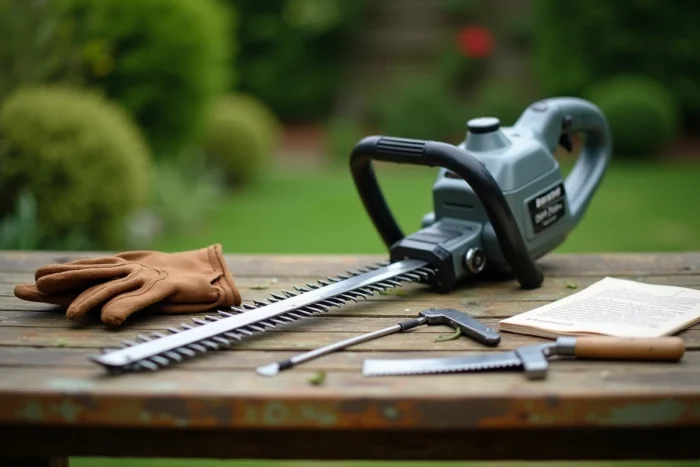
Secure Storage of Lithium-ion Batteries
This topic is almost absent from consumer comparisons, while recent industry recommendations emphasize precautions related to lithium-ion batteries in gardening tools. The main risk is thermal runaway, which can occur during charging or storage in an environment that is too hot.
Good practices to remember:
- Charge the battery in a ventilated space, ideally on a fireproof surface, never in a closed room without a smoke detector.
- Do not leave a battery plugged into the charger beyond full charge, especially with entry-level chargers lacking automatic cutoff.
- Store batteries at moderate room temperature, away from heat sources (radiator, sun-exposed window, thermal engine).
- Regularly inspect the casing: a swollen, cracked, or abnormally hot battery should be removed from the tool and recycled at a collection point.
This point of vigilance concerns all cordless gardening tools, but it takes on particular importance with a telescopic hedge trimmer: the battery is often removed from the device between uses spaced weeks apart, and careless storage in a hot garden shed during summer increases the risks.
The choice of a telescopic hedge trimmer ultimately hinges on three concrete axes: a balance that preserves your shoulders over time, an autonomy calibrated to the actual density of your hedge, and battery storage that does not turn your shed into a hot spot. Testing the tool in hand, pole extended and battery mounted, remains the best filter before purchase.