Christine Laure, a women’s ready-to-wear brand founded in Gray in 1961, underwent a judicial recovery procedure opened in August 2024 at the commercial court of Dijon. On November 28, 2025, the same court accepted the offer from the northern group Amoniss to take over the brand, involving a significant restructuring: approximately 84 positions out of 284 were eliminated, nearly one-third of the workforce.
Judicial Recovery of Christine Laure: The Timeline of a Rapid Crisis
The management of Christine Laure requested placement in judicial recovery during the summer of 2024. This collective procedure opened a six-month observation period, extended by the commercial court of Dijon to allow candidates time to structure their takeover offers.
Three offers were in competition: that of the Antonelle-Un Jour Ailleurs-Kookaï group, that of the Lyon-based manufacturer Avona, and that of Amoniss, the holding company of Salih Halassi. The court decided at the end of November 2025 in favor of Amoniss, notably because this offer included the retention of the majority of the sales outlets.
What is even more concerning is the speed of the financial deterioration. A brand that still had several hundred employees and a dense network of physical stores found itself unable to cover its debt in just a few months. The question about the future of the Christine Laure brand then arose for the entire sector.
Amoniss’s Multi-Brand Strategy: What It Means for Christine Laure
The acquirer is not an isolated investor betting on a single brand. Amoniss has acquired several fashion brands, including Pimkie, JOTT, Chevignon, and Lepape. Christine Laure is therefore part of a portfolio of brands managed by the same holding company, through its subsidiary Diramode.
This approach allows for the pooling of certain costs: logistics, information systems, supplier negotiations. For a weakened brand, this pooling can represent a short-term survival lever.
The risk, however, is one of dilution. When a group simultaneously manages brands with different positioning (streetwear for Pimkie, outdoor for JOTT, classic for Christine Laure), the attention given to each brand depends on the financial decisions of the group. A brand that is less profitable than its portfolio neighbors may gradually become under-invested.
The Precedent of Pimkie and Chevignon
Pimkie, another acquisition of Amoniss, was also undergoing a deep restructuring before its takeover. Chevignon, a historic brand from the 1980s-1990s, had lost most of its commercial visibility.
The emerging pattern is that of a buyer specialized in struggling brands, betting on the residual value of the name and the network. The question for Christine Laure is whether this model leads to real redevelopment or to a managed decline.
Closure of Christine Laure Stores: Which Stores Are Affected
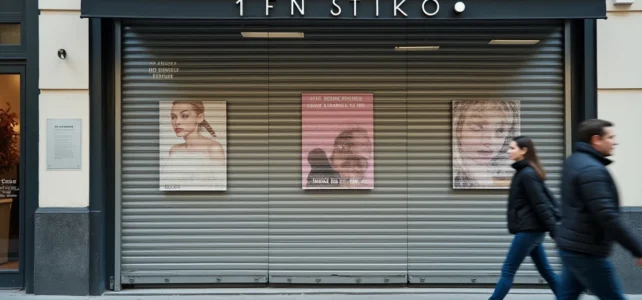
The takeover offer does not retain the entire network. About one-third of the workforce has been cut, which implies the closure of several dozen sales outlets. Stores located in medium-sized city centers, where foot traffic has significantly decreased in recent years, are the most exposed.
The retained stores correspond to the most profitable locations or those best situated in high-traffic commercial areas. The logic is classic in network takeovers: keep the profitable links, close the others.
- Stores in high-traffic shopping malls are more likely to be retained than those in medium-sized city centers
- Stores whose leases are expiring soon are often the first to close, as the acquirer avoids renewing costly commitments
- Owned (non-franchised) stores are easier to close at the group’s decision, without negotiation with a third-party operator
For customers accustomed to visiting a nearby Christine Laure store, the closure means a shift towards online sales or other brands in the same segment.
Classic Women’s Ready-to-Wear in France: A Segment Under Structural Pressure
The closure of Christine Laure stores is not an isolated case. The segment of classic women’s ready-to-wear, targeting customers over 50 with mid-priced collections, has been under constant pressure for several years.
Several factors are compounding:
- The competition from online platforms, which offer similar ranges with flexible return policies
- The decline in foot traffic in medium-sized city centers, where these brands were historically located
- The aging of the loyal customer base without sufficient renewal among subsequent generations
- The rise in operating costs (rent, energy, social charges) weighing on already thin margins
Other brands in the same segment have experienced similar trajectories: Camaïeu was liquidated, Naf Naf and Kookaï have changed hands several times. Mid-range physical ready-to-wear is the most vulnerable segment of fashion retail in France.
Online Sales for Christine Laure: A Channel Yet to Be Structured
The e-commerce site for Christine Laure existed before the takeover, but its share of total revenue remained marginal compared to the physical network. For Amoniss, developing this channel is an arithmetic necessity: with fewer stores, online sales must compensate for some of the lost revenue.
The difficulty lies in the customer profile. Loyal customers of Christine Laure value in-store fitting, advice, and proximity. Shifting this clientele to a digital shopping experience requires investment in user experience, size guides, and return policies.
Amoniss has a potential advantage: the pooling of the e-commerce logistics platform with its other brands. If JOTT or Pimkie already have a well-established online sales infrastructure, Christine Laure could benefit without starting from scratch.
The Christine Laure brand retains strong recognition among its target audience. The name, color codes, and positioning in the classic women’s wardrobe remain exploitable assets. What will determine the future is the acquirer’s ability to transform these assets into traffic, both online and in-store, without allowing the brand to become just a name on a holding company’s catalog.