
The average wedding in France involves several months of preparation, about ten service providers, and a budget that regularly reaches five figures. Organizing a stress-free wedding requires fewer miracle recipes than making decisions at the right time, in the right order, with a realistic margin to absorb unexpected events.
Two-Day Wedding: The Stress No One Plans For
The majority of planning guides focus on the wedding day. Recent data shows another reality: more than one in two couples wants to extend the celebration over two days, with a brunch the next day, often at a venue with on-site accommodation.
This extended format generates friction points that are rarely anticipated. Coordinating two separate catering services, managing late arrivals in the evening and staggered departures on Sunday, negotiating group rates for rooms: each element adds a logistical layer that does not exist in a traditional one-day wedding.
Before confirming a venue with accommodation, many couples discover on the Actu Mariage website for organizing their wedding that the real gain in serenity comes from geographical clustering: ceremony, reception, and accommodations within a limited area to avoid transfers between sites.

Wedding Budget: Prioritize Rather Than Plan Everything
Setting a global budget at the beginning of preparations is a common reflex. The problem is that this figure quickly becomes fictitious if the items are not prioritized from the start.
Identify the Three Non-Negotiable Items
For each couple, three expenses concentrate the bulk of the financial and emotional burden. The venue, the caterer, and the photographer consistently appear in feedback from newlyweds as the areas where misplaced savings generate the most regrets.
Booking these three providers as a priority frees up the rest of the budget for more flexible choices: decoration, entertainment, guest gifts. This prioritization approach avoids the classic spiral where each received quote chips away at the initially planned margin.
The Contingency Margin: A Budget Item in Its Own Right
Field feedback varies on the exact percentage to set aside for contingencies. However, what consistently comes up is that couples with no budget reserve experience disproportionate pressure in the final weeks of preparation. Setting aside a dedicated envelope, even a modest one, transforms an unexpected event into an adjustment rather than a crisis.
Intimate Weddings: Reducing the Guest List to Reduce Stress
The trend documented in recent years leans towards small weddings, with around fifty guests or fewer. This choice is not solely a budget issue.
Fewer guests mean mechanically fewer service providers to coordinate, fewer table plans to manage, and less family tension over the guest list. The time spent with each guest increases, aligning with the growing demand for weddings focused on relational quality rather than reception size.
- Fewer logistical decisions on a daily basis during preparations (transport, accommodation, seating)
- A more contained overall budget, with a wider margin on each item
- A reduced mental load on the big day, as the number of contacts decreases for both the couple and the witnesses
The available data does not allow for a universal threshold. However, reducing the guest list by half also divides the organizational complexity, which is the most direct lever for a stress-free wedding.
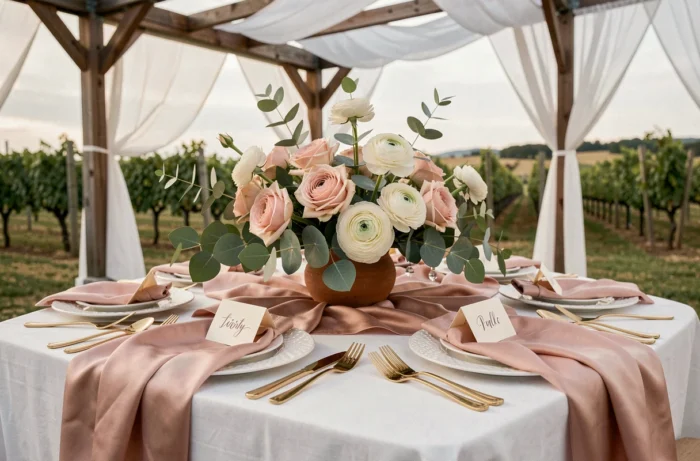
Wedding Planning: Structuring Decisions by Quarter
Most couples start their preparations between twelve and eighteen months before the date. The classic trap is wanting to handle everything in parallel from the start, which leads to decision overload in the initial weeks.
Structuring decisions into quarterly blocks allows for spreading the load over time. The first quarter is dedicated to locking in the trio of venue, caterer, and photographer. The second focuses on clothing choices and decoration. The third covers invitations, the seating plan, and coordination on the big day.
- Quarter 1: venue, caterer, photographer (the most sought-after providers, to be booked early)
- Quarter 2: attire for the couple, decoration, musical entertainment, guest gifts
- Quarter 3: sending invitations, final seating plan, logistical coordination with the witnesses
- Last month: final confirmations, possible rehearsal of the ceremony, delegation of tasks for the big day
Each block closes before opening the next. This sequencing avoids back-and-forth between unrelated topics, such as choosing a DJ while negotiating the menu.
The Most Common Timing Mistake
Postponing the seating plan to the final weeks is a source of stress documented by nearly all feedback from newlyweds. This task takes time, generates couple discussions, and depends on late confirmations. Starting it at least six weeks before the wedding, even in draft form, significantly reduces final pressure.
Delegating on the Big Day: The Most Underestimated Decision
On the wedding day, the couple should not manage any logistics. This statement seems obvious, but in reality, the majority of couples retain a coordinating role due to not having explicitly delegated each task.
Designating a point person, whether a witness, an organized friend, or a professional coordinator, radically changes the experience of the day. This person has the list of providers, the scheduled times, and a contact number for each participant.
Hiring a wedding planner for just the wedding day (known as “day-of coordination”) is available at rates much lower than full support. For couples who have organized everything themselves, this is often the budget item that generates the best return in terms of serenity.
A stress-free wedding does not rely on the absence of unexpected events, but on an organization that absorbs them without the couple having to intervene. Sequencing decisions, reducing variables, and delegating coordination on the big day remain the three most concrete levers to achieve this.