
Between two mowings, the fuel level in your gas mower drops faster than expected. Before suspecting a leak or engine defect, you should consider the fuel itself, the condition of the air filter, and how the machine is stored between uses. These three factors, often combined, explain the vast majority of the excessive fuel consumption observed in lawn mowers.
Fuel type and mower consumption: what ethanol changes
The choice of fuel has a direct effect on consumption. The SP95-E10, available at most French stations, contains up to 10% ethanol. The energy content of ethanol is lower than that of pure gasoline, which mechanically results in a slight increase in consumption for the same mowing work.
The real problem arises when this gasoline remains in the tank for several weeks. Briggs & Stratton and Honda indicate that gasoline starts to degrade after about a month of storage. Ethanol accelerates this phenomenon by attracting moisture, which promotes the formation of gummy deposits in the carburetor. A partially clogged carburetor forces the engine to run with a mixture that is too rich, leading to noticeable overconsumption.
To delve deeper into this mechanism and its consequences on the engine, a detailed file discusses fuel consumption on tondeuse-thermique.info by reviewing each technical cause.
| Fuel | Ethanol Content | Storage Stability | Risk to Carburetor |
|---|---|---|---|
| SP95-E5 | Up to 5% | Good (a few months) | Low |
| SP95-E10 | Up to 10% | Degrades after about a month | Moderate to high |
| E85 | Up to 85% | Not approved by most manufacturers | High (seals, hoses) |
| Alkylate gasoline | 0% | Very good (several months) | Very low |
Alkylate gasoline, free of ethanol, stands out for its storage stability. It produces fewer deposits and is particularly suitable for mowers used occasionally. In contrast, super ethanol E85 is classified among fuels not approved by Briggs & Stratton: it can damage the seals and hoses in the fuel system, ultimately causing malfunctions and increased consumption.
Clogged air filter and obstructed carburetor: the duo that undermines engine performance
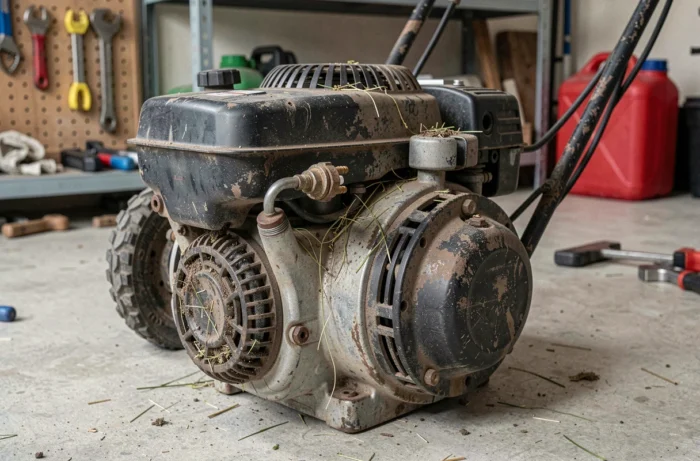
A dust-saturated air filter reduces the airflow entering the engine. To compensate, the carburetor injects proportionally more gasoline. The engine then runs on a rich mixture, which increases consumption and often generates black smoke from the exhaust.
This phenomenon is self-perpetuating. A mixture that is too rich produces incomplete combustion residues that clog the spark plug. A clogged spark plug degrades the spark, making combustion even less efficient, and the engine consumes more to maintain its speed.
Symptoms to watch for
- The engine loses power during mowing, and the speed becomes unstable, indicating insufficient air intake.
- Black or gray smoke comes from the exhaust, indicating too rich a mixture due to lack of air.
- Starting becomes difficult or the engine stalls at idle, often related to a spark plug clogged by combustion deposits.
- Gasoline consumption noticeably increases from one mowing to the next without changes in area or grass height.
Cleaning or replacing the air filter is the simplest and most cost-effective intervention. A clean filter restores the air/fuel ratio intended by the manufacturer and brings consumption back to a normal level.
Crust under the deck and cutting height: two underestimated mechanical factors
The accumulation of dried grass under the cutting deck forms a compact crust that reduces the available space for the blade’s rotation. The engine must exert extra effort to maintain cutting speed, resulting in increased strain and higher consumption.
This phenomenon worsens when mowing is done on wet grass. The residues stick more to the deck wall and form a thicker layer, which is harder to remove. Cleaning the underside of the deck after each use, using a spatula or a water jet (engine off, spark plug disconnected), prevents this accumulation.

Cutting height and engine load
Mowing very tall grass in a single pass forces the engine to work at full load continuously. The resistance posed by dense grass increases the torque required, and thus the fuel consumption. Gradually lowering the cutting height over two passes reduces the load on the engine with each pass.
Winter storage of fuel: the invisible cause of overconsumption in spring
A mower stored for several months with gasoline in the tank often restarts with difficulty in spring. The degraded gasoline has formed deposits in the carburetor, the spark plug may be gummed up, and the first start is accompanied by overconsumption due to a poorly running engine.
Two approaches exist to avoid this scenario:
- Completely drain the tank and run the engine until it stops due to lack of fuel, which also purges the carburetor circuit.
- Fill the tank with alkylate gasoline (ethanol-free) before storage, as its stability allows it to be preserved for several months without degrading.
- Replace the spark plug and clean the air filter before the first mowing of the season, to start with a clean intake system.
The combination of these precautions helps avoid the phase of overconsumption that generally accompanies the first mowings after winter. An engine that starts easily and runs at a stable speed from the first minutes consumes significantly less than an engine that struggles to find its speed.
The most determining factor remains the freshness of the fuel. Gasoline less than a month old in a properly maintained engine consumes what the manufacturer has planned, without surprises. Each additional week of storage in the tank brings the mower closer to degraded operation, where the engine compensates by burning more fuel for the same mowing result.