
The additional birth leave, which comes into effect on July 1, 2026, in France, redefines the legal framework for paternal presence with the newborn. This measure, which adds to the existing paternity leave, grants each parent an additional one to two months of paid leave. Fathers now have an unprecedented arsenal of rights to support them during the early months of their child’s life.
Additional birth leave 2026: what the law changes for fathers
The paternity and child care leave, extended to 28 days with 7 mandatory days since 2021, was already a significant advancement. The new additional birth leave goes further: it allows each parent to take an additional one to two months, compensated at 70% of gross salary for the first month and then 60% for the second, up to the monthly Social Security ceiling set at 4,005 euros gross as of January 1, 2026.
This leave can be taken by both parents simultaneously or successively, up to nine months after the birth or arrival of the child in the household. In practice, a salaried father can now combine traditional paternity leave with additional leave, which means several consecutive weeks with his child. This measure, included in Article 99 of the Social Security financing law for 2026, positions France in a catch-up logic compared to Nordic countries.
To find all the news from Allo Papa on parental rights and recent legislative developments, regular monitoring of these reforms remains useful as parameters change quickly.
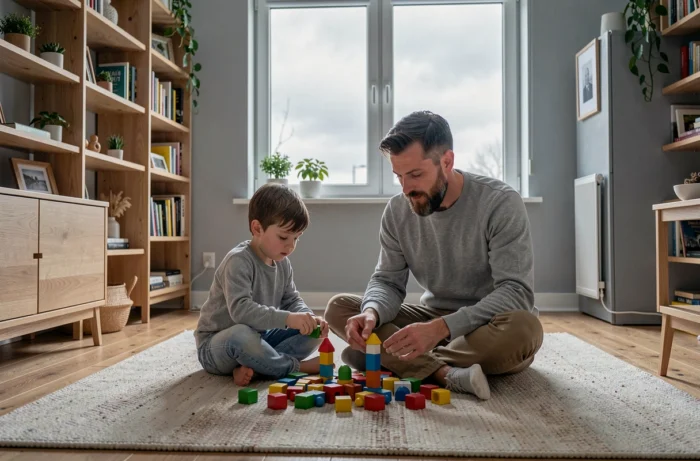
Fathers’ involvement in daily life: beyond legal leave
A right only takes effect if it is exercised. The trend observed in recent years shows that the majority of fathers now take their paternity leave in full. The main barrier remains the fear of a professional impact, particularly in small organizations or sectors where presenteeism dominates.
Mental load and household tasks
Legal leave covers only a fraction of the first year. The challenge for today’s fathers mainly lies in the daily distribution of tasks: meal preparation, medical follow-ups, sleep management, and organizing childcare. Early paternal presence facilitates a more balanced sharing in the long term.
Several studies reported by specialized media highlight that a father’s involvement from the first weeks permanently alters the dynamics of the parental couple. A father who took extended leave at the time of birth is more involved in child care months later.
Maternal penalty and professional equality
The issue of the maternal penalty, meaning the income and career gap that mothers face after childbirth, also directly concerns fathers. When a father takes extended leave, the mother returns to work earlier or under better conditions. The 2026 reform explicitly aims to reduce this asymmetry by making leave equally accessible to both parents.
Educational trends and new benchmarks for dads
The paternal role is no longer limited to that of an authority figure or financial provider. Educational content aimed at fathers is multiplying, with various formats: podcasts, short video clips, online communities. The approach using humor and sharing concrete experiences is gradually replacing prescriptive manuals.
- Podcasts dedicated to fatherhood address topics long considered taboo: paternal perinatal mental health, sexuality after childbirth, managing chronic fatigue.
- Video clips produced by associations or regional media offer raw testimonials from fathers, without filters or staging, which encourages identification.
- Online father communities allow for peer-to-peer exchanges on practical questions (equipment choices, time management, relationships with daycare or school).
A father seeking educational benchmarks now finds resources designed specifically for him, rather than adaptations of content originally intended for mothers. This distinction, still recent, changes how fathers construct their parental identity.

Birth rate in France and the father’s role in family policies
France is undergoing a period of questioning the effectiveness of its family policies. A recent report shared by Vie publique questions the relevance of the expenditures made to support birth rates. In this context, the father’s role becomes an explicit political lever: by facilitating the taking of paternity leave, the state hopes to both support birth rates and reduce gender inequalities at work.
The creation of additional birth leave is part of a broader legislative package. The Medef has taken a stance on the single parental leave, proposing a comprehensive overhaul of the system. The idea of identical parental leave for both parents, sufficiently compensated to be genuinely taken by fathers, is gaining traction in public debate.
- The compensation rate remains the determining factor: poorly paid leave will mostly be taken by the parent with the lowest income, often the mother.
- The total cumulative duration of French parental leaves is now approaching that observed in Scandinavian countries, even if the level of compensation remains lower.
- The legal framework is not enough without a cultural change in companies, where taking leave by a father is still sometimes perceived as a lack of professional commitment.
The coming years will tell if this accumulation of rights translates into a lasting change in practices. For fathers welcoming a child in 2026, the framework has never been more favorable. The question shifts from rights to usage, and from usage to the surrounding corporate culture.