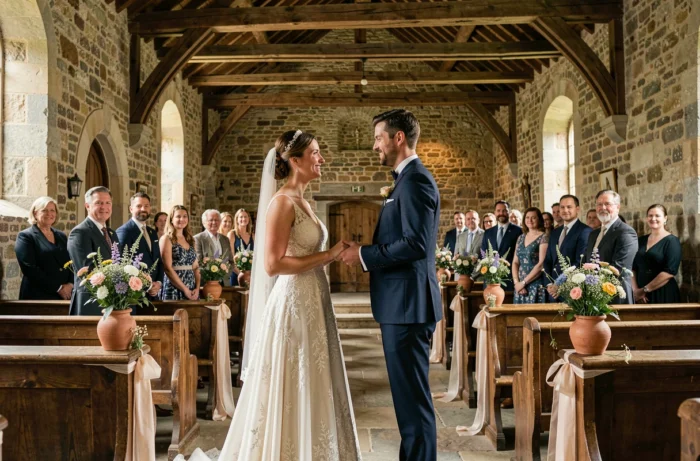
Organizing a wedding involves skills that one has never had the opportunity to practice: negotiating with a caterer, comparing reception venues, mediating between the couple’s desires and the expectations of their loved ones. Most guides offer numbered step-by-step lists. Here, the approach is different: we focus on the decisions that have the most impact on the final outcome, those where a mistake can be costly in terms of time, money, or peace of mind.
Wedding Budget: the couple finances, the parents contribute
You may have in mind the image of a wedding funded by families. This model is fading. Today, the couple pays between 50 and 70% of the budget from their own savings, while parents provide a pre-announced flat donation. The traditional distribution (bride’s family for the reception, groom’s family for the rest) has almost disappeared.
This change has a direct consequence on the organization. When you manage the budget yourself, each expense item becomes a personal negotiation. It is better to set a realistic overall amount from the start, then allocate the envelopes by priority rather than by tradition.
To discover everything about organizing with Rêve 2 Mariage, you just need to delve into each item one by one: venue, caterer, photographer, decoration. Each item has its own negotiation margins.
Identifying high variance items
The reception venue and the caterer often take up the largest part of the budget. But these are also the items where the price difference can be the widest from one provider to another. The same seated meal can vary from one to three times depending on the chosen venue.
Compare at least three quotes for each major item before signing anything. Always ask for a detailed line-by-line breakdown: an “all-inclusive” package sometimes hides additional costs (tablecloths, setup, corkage).
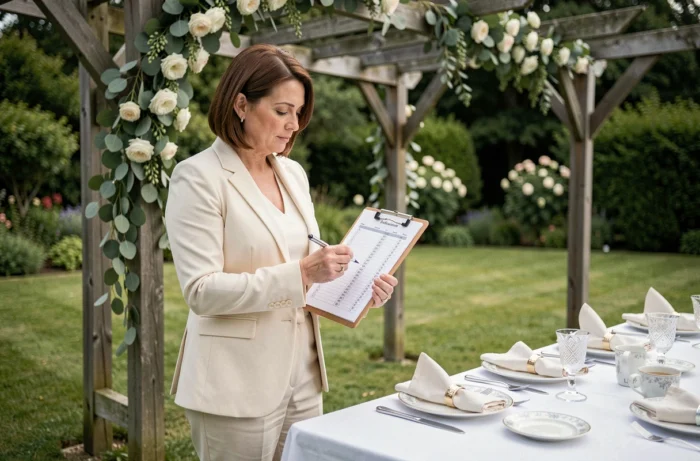
Reception venue and guest list: two linked decisions
Why address these two topics together? Because they condition each other. A beautiful venue that accommodates a maximum of 80 people forces you to reduce your list. Conversely, a list of 150 guests automatically rules out small intimate venues.
The most effective method is to first set a range of guests (for example, between 80 and 120), then look for venues compatible with this gauge. Booking the venue before stabilizing the list risks paying for too large a space or turning away loved ones due to lack of space.
Three often underestimated criteria for the venue
- Accessibility for guests coming from afar: proximity to a train station or a major road, accommodations available within 15 minutes. An isolated venue without lodging options generates cancellations.
- The actual capacity in real configuration, not theoretical: a venue advertised for 150 people can become uncomfortable once the dance floor, DJ, and buffet are set up.
- End-of-evening time constraints: some venues impose a stop to the music before midnight due to neighbors, which radically changes the atmosphere.
Preparation timeline: what to book first
The common reflex is to start with what is appealing: the wedding dress, decoration, stationery. In practice, the most sought-after providers can sometimes be booked a year in advance. The reception venue, caterer, and photographer are the three items to prioritize.
Once these three bookings are made, the rest of the organization is structured around fixed dates. The florist, DJ, stationery, and rings can wait a few more months without risk.
The trap of a too-tight schedule
Many couples decide to finalize everything well in advance to “not think about it anymore.” The result: hasty choices on providers they haven’t had time to compare, and deposits paid too early on options they later regret.
Leave three to four weeks between each major decision. This pace allows for digesting each choice, comparing calmly, and keeping energy for the next steps. Organizing a wedding takes several months: there’s no need to compress everything into the first few weeks.

Wedding providers: what a well-read quote reveals
A provider’s quote is not just a price. It is a miniature contract. Before signing, check what the amount includes and, most importantly, what it excludes. Unanticipated extras (travel costs, overtime, weekend surcharges) can significantly increase the final bill.
- Request a detailed quote with each service on a separate line. A single overall amount without breakdown makes any comparison impossible.
- Check the cancellation and rescheduling conditions: some contracts stipulate the full retention of the deposit even in case of rescheduling, while others offer a date transfer.
- Ask if the provider works alone or with a team. For a photographer or videographer, knowing who will be present on the big day (and not just who signs the quote) changes the game.
The mistake of choosing solely based on portfolio
A stunning Instagram portfolio says nothing about punctuality, responsiveness, or stress management on the day of the ceremony. Before booking, have a video or face-to-face conversation. Ask questions about a wedding that didn’t go as planned: the answer reveals more than a perfectly curated feed.
A well-organized wedding is not one where everything is controlled, but one where the right decisions were made at the right time. The venue, budget, and providers form the structuring triangle. Everything else (decoration, gifts, entertainment) attaches to this with much less friction when these three pillars are solid.