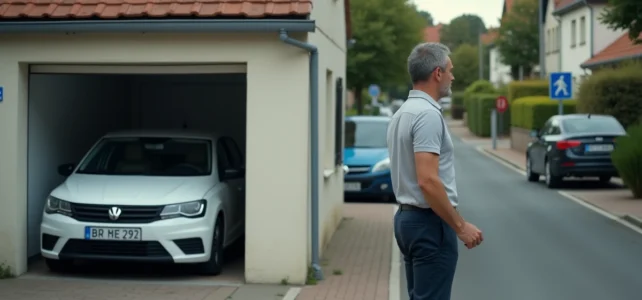
The regulatory distance when exiting a garage is a topic that generates a lot of confusion among drivers. The French Highway Code does not set any precise metric threshold for parking near a vehicle entrance. This apparent ambiguity gives rise to two distinct classifications, with very different penalties, and to municipal orders that vary from one municipality to another.
Inconvenient or dangerous parking near a garage: two offenses, two scales
The distinction between inconvenient parking and dangerous parking determines the amount of the fine, the withdrawal of points, and the possible towing. The table below summarizes the differences between these two classifications applied to parking in front of a garage exit.
| Criterion | Inconvenient parking | Dangerous parking |
|---|---|---|
| Fixed fine | 35 € | 135 € |
| Points withdrawal | None | 3 points |
| Towing | Possible depending on context | Possible |
| Reference text | Article R417-10 of the Highway Code | Article R417-9 of the Highway Code |
| Typical example | Vehicle parked in front of a vehicle entrance on a clear roadway | Vehicle obstructing visibility when exiting a garage near a turn or intersection |
The gap between the two is considerable. A vehicle parked in front of your garage on a straight street will generally be classified as inconvenient. The same vehicle placed near a turn, a hilltop, or an intersection, reducing visibility for someone exiting the garage, shifts into the category of dangerous parking with a withdrawal of 3 points.
To better understand these distinctions and anticipate risky situations, Déclic Auto’s practical advice details the most common scenarios in urban areas.

No minimum distance in the Highway Code: what this changes concretely
Many drivers look for a specific number, such as five meters or three meters, thinking that a regulatory threshold exists. This is not the case. The Highway Code prohibits parking in front of vehicle entrances, but does not set any minimum distance in meters.
This absence of a threshold has a direct consequence: the qualification of the offense relies on the assessment of the enforcing officer. Two criteria come into play:
- Does the parked vehicle physically prevent access to the garage or the exit of the vehicle inside? If so, the parking is inconvenient under Article R417-10.
- Does the parked vehicle reduce the visibility of the driver exiting the garage towards the public road, especially near a crossroads or a turn? If so, the classification may shift to dangerous parking, with a significantly heavier penalty.
- Has the parking lasted more than seven consecutive days in the same spot? In this case, it may be reclassified as abusive parking, which opens the door to towing regardless of the inconvenience observed.
In the absence of a quantified distance, it is therefore the configuration of the roadway that determines the severity of the offense. A wide street with good visibility does not pose the same risk as a narrow sloped alley.
Municipal orders and local tolerance: a variable framework depending on municipalities
Municipalities have the power to issue complementary orders regarding parking. Some municipalities establish regulated parking zones around garage entrances, with specific ground markings (yellow lines, lowered curbs indicated by a sign).
Practitioners of traffic law report a temporary tolerance from certain municipalities when the parked vehicle does not encroach on the sidewalk or roadway. This tolerance has no legal value and does not prevent a ticket if an officer observes an inconvenience or danger.
Lowered curb and ground marking
The curb (lowering of the sidewalk in front of a vehicle entrance) serves as a clear visual signal for other drivers. Parking on a lowered curb is systematically subject to fines, even in the absence of an additional prohibition sign.
Some municipalities add vertical signage (no parking sign with time restrictions) or horizontal (continuous yellow line along the sidewalk). These measures enhance the possibility of fines and limit the officer’s discretion.
What to do when a vehicle blocks your garage exit
The first step remains to report to the municipal police or gendarmerie, which can verify the offense and issue a ticket. If the vehicle has been parked for several days, the classification as abusive parking allows for a request for towing.
Placing a “no parking” sign on your garage door has no regulatory value in French law. Only the mayor, through a municipal order, can create a parking prohibition enforceable against third parties. A private sign may deter, but does not establish any legal recourse.

Garage exit and responsibility in case of a collision
The driver exiting a garage onto the public road must yield to vehicles traveling on the roadway and to pedestrians on the sidewalk. This priority rule, provided by the Highway Code, applies even if a parked vehicle nearby reduces visibility.
In the event of a collision while exiting, the responsibility of the driver emerging is primarily engaged. The presence of a poorly parked vehicle nearby may be a mitigating factor in the insurance analysis of the incident, but it is not enough to absolve the exiting driver of responsibility.
This distribution of responsibility explains why visibility when exiting a garage is both a road safety issue and a parking issue. A vehicle parked too close, even without violating a quantified regulatory distance, can create conditions for an accident for which the exiting driver will bear the burden.
The French legal framework thus leaves a wide margin of appreciation to officers and judges. The best protection remains to document recurring situations (timestamped photos, repeated reports) and to request a municipal order if your garage exit is in a risky configuration.