
Converting 1/4 liter to centiliters involves solving a placement problem in the metric table. The answer lies in one operation: 1/4 liter = 25 cl. However, between theory and practice in the kitchen, dosage errors often occur due to confusion between units or poorly calibrated utensils. This article measures the actual discrepancies between different conversion methods and their consequences on your recipes.
Metric Volume Table: From Liter to Milliliter
Before converting, it’s essential to understand the logic of the metric system applied to liquid volumes. Each unit differs from the next by a factor of 10, and moving from liters to centiliters means shifting two columns to the right in the conversion table.
| Fraction of a liter | Centiliters (cl) | Milliliters (ml) | Deciliters (dl) |
|---|---|---|---|
| 1 liter | 100 cl | 1,000 ml | 10 dl |
| 1/2 liter | 50 cl | 500 ml | 5 dl |
| 1/3 liter | 33.3 cl | 333 ml | 3.3 dl |
| 1/4 liter | 25 cl | 250 ml | 2.5 dl |
| 1/5 liter | 20 cl | 200 ml | 2 dl |
| 1/10 liter | 10 cl | 100 ml | 1 dl |
Multiplying by 100 to convert from liters to centiliters is the most common source of error. Sometimes, centiliters and milliliters are confused, which amounts to multiplying by 10 instead of 100 (or vice versa). The key point to remember is: 1 cl always equals 10 ml.
To master the conversion of 1/4 liter to cl, simply divide 100 by 4 to get 25 cl, or 250 ml.
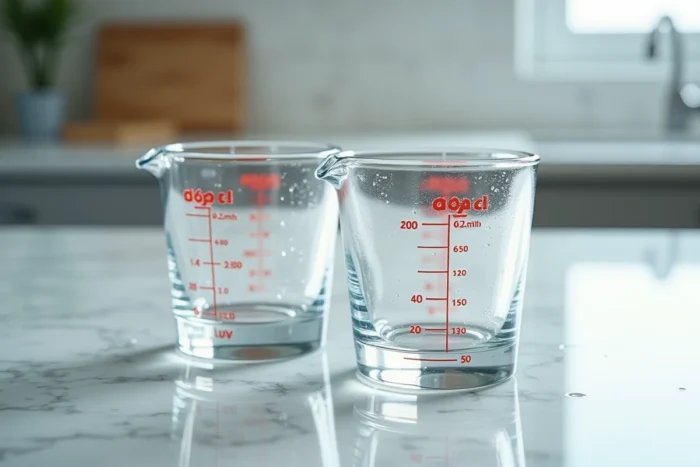
Glass, Cup, Yogurt Pot: Comparative Reliability of Measuring Utensils
French recipes often use household references to express volumes. The problem is that these references do not always correspond to the same capacity.
A table glass can hold 12 cl, 20 cl, or 25 cl depending on its shape, manufacturer, and the country of origin of the recipe. Using “a glass” as a substitute for 25 cl without checking its actual capacity introduces a margin of error that can reach double the expected volume.
- The standard yogurt pot offers the most consistent reference: its capacity is standardized and corresponds to about 12.5 cl, or half of a quarter liter.
- The classic coffee cup varies by model, but measuring cups sold for cooking generally display precise graduations in cl and ml.
- The tablespoon represents about 1.5 cl, allowing you to make up 25 cl by counting about fifteen tablespoons, a tedious but functional method in the absence of a measuring cup.
On the other hand, a graduated measuring cup remains the only utensil that guarantees a reliable reading of the volume. Other household references serve as backups, not as standards.
Comma Errors and Scale Reading: Where Mistakes Happen in the Kitchen
The conversion between liters, centiliters, and milliliters is arithmetically simple. Errors almost never arise from bad calculations but from misplacing the comma or confusing units when reading the recipe.
Confusing 25 cl and 25 ml divides the quantity by 10. For a pancake batter, this means barely two tablespoons of milk instead of a large glass. The result is a compact and unusable batter.
The reverse trap also exists. A recipe that calls for 25 ml of olive oil (or 2.5 cl) can be interpreted as 25 cl if the abbreviations are confused. The dish ends up drowning in fat.
To avoid these errors, a reliable method is to always convert the measurement to milliliters before dosing. The milliliter is the smallest unit in the current table, and the graduations of measuring cups use it as a base. Converting first to ml eliminates the risk of confusion between cl and dl.
The Case of Anglo-Saxon Recipes
English recipes use cups, tablespoons, and fluid ounces. A quarter liter does not exactly correspond to a US cup. The US cup represents about 23.7 cl, which is a difference of more than one centiliter from the 25 cl of the metric quarter liter.
On a single measurement, the difference remains minimal. In a recipe that calls for three or four cups, the cumulative difference can exceed 5 cl, which alters the texture of a pastry or the consistency of a sauce.

Conversion of 1/4 Liter to cl: Key Points to Remember
Two key points are enough to never hesitate on volume conversions in the kitchen:
- From liters to centiliters, multiply by 100. From centiliters to milliliters, multiply by 10. Always in that order.
- A quarter liter equals 25 cl or 250 ml. Two standard yogurt pots filled to the brim give a very close volume.
- A graduated measuring cup remains the only tool that eliminates approximations. Household references (glass, cup, spoon) are useful, but their capacity varies too much to be reliable in baking.
Baking tolerates very little dosage variation, unlike savory cooking where seasoning can be adjusted at the end of cooking. For any sweet recipe that mentions a quarter liter, measuring with a graduated measuring cup in milliliters remains the safest method.