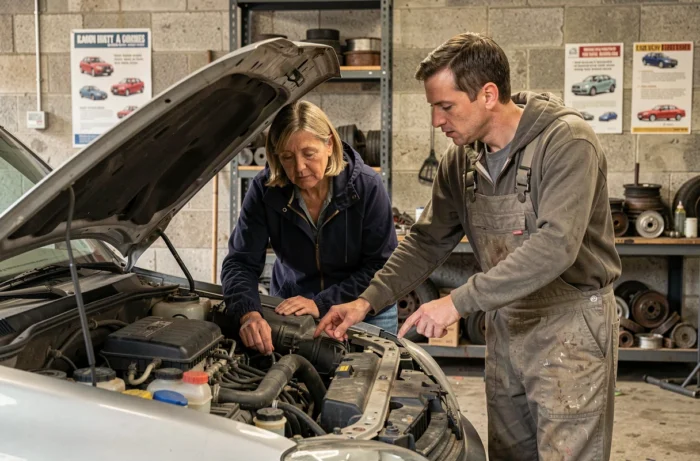
Buying a car at a low price through a solidarity garage requires checking much more than just the displayed price. The purchase price, often significantly lower than that of the traditional used car market, reflects only part of the actual cost. Before signing, one must assess the vehicle’s compatibility with local traffic restrictions, estimate upcoming maintenance costs, and understand the access conditions to these structures.
Actual cost of a solidarity car: beyond the purchase price
Solidarity garages offer used vehicles that have been serviced at prices significantly lower than those charged by dealerships or private sale platforms. This difference is explained by the associative model of these structures, which receive vehicle donations, restore them with the help of employees in integration or volunteers, and then sell them at a price that mainly covers parts and labor.
The displayed price represents only a fraction of the total budget. Insurance, registration, regular maintenance, and wear parts add to the initial price. For an older vehicle, expenses for tires, brakes, and timing belts can increase the bill in the months following the purchase. Some solidarity garages include a short warranty or mechanical follow-up, but this is not systematic.
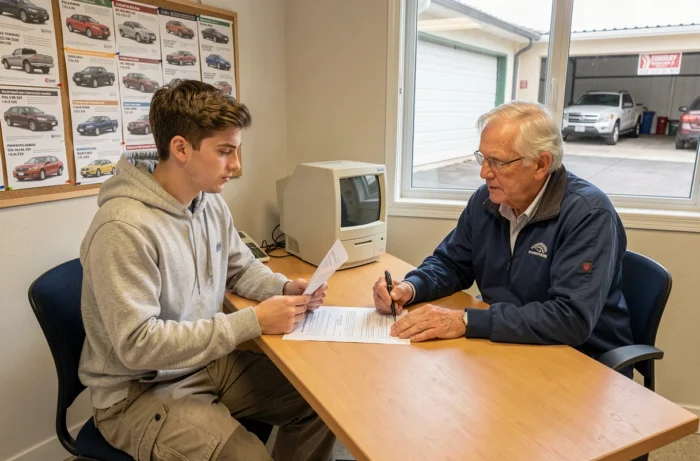
To find a car at Your Solidarity Garage, you generally need to be referred by a social worker (local mission, CCAS, France Travail, CAF) and meet income or professional situation criteria.
| Expense item | Solidarity garage | Traditional used car |
|---|---|---|
| Purchase price | Very below market | Market price |
| Pre-sale inspection | Included (restoration) | Variable (not always done) |
| Mechanical warranty | Short or absent depending on the structure | Legal compliance warranty |
| Access | Subject to social conditions | Free |
| Post-purchase follow-up | Sometimes offered at a reduced rate | Rarely included |
Crit’Air sticker and low emission zones: the overlooked trap
This is the blind spot of most guides on solidarity garages. A vehicle sold at a low price can become unusable if its Crit’Air classification is incompatible with the low emission zone (ZFE) of the area where the buyer resides or works.
The ZFEs, in effect in several French metropolitan areas, progressively prohibit the circulation of the most polluting vehicles. A Crit’Air 4 or 5 vehicle purchased at a low price may be banned from circulation where the buyer needs it most. Before any purchase, it is essential to check the date of first registration of the vehicle, its type of engine, and the restrictions in place in its area of residence.
Solidarity garages do not systematically filter their stock according to this criterion. The responsibility for verification falls on the buyer or the social prescriber accompanying them.
Points to check before finalizing a purchase
- The Crit’Air classification of the vehicle, available online from the registration certificate. A diesel vehicle from before 2006 or a gasoline vehicle from before 1997 falls into category 4 or 5, potentially excluded from ZFEs.
- The traffic restrictions in effect in the metropolitan area of residence and on the home-work route. Some ZFEs still allow Crit’Air 3, others do not.
- The status of the technical inspection, which must be up to date and without a follow-up visit. Even if the solidarity garage has serviced the vehicle, the technical inspection remains a legal document to demand.
- The availability of spare parts for the model in question. For an older vehicle, some parts become rare and expensive.
Electric vehicles in solidarity garages: a recent initiative
Used electric vehicles are beginning to enter solidarity circuits. The Ministry of Ecological Transition has announced a specific program aimed at home helpers, designed to give them access to refurbished electric vehicles. This type of program targets professionals whose daily trips are short but frequent, a profile compatible with the limited range of used batteries.
The arrival of electric vehicles in the solidarity network changes the total cost equation. The purchase price remains moderate, and fuel costs disappear. However, the condition of the battery becomes the main risk factor. A degraded battery may require a replacement whose cost exceeds the value of the vehicle.
For now, the offer remains limited. The majority of vehicles available in solidarity garages are entry-level or mid-range thermal cars, often with high mileage.
Fleet car sharing: an alternative when buying remains too burdensome
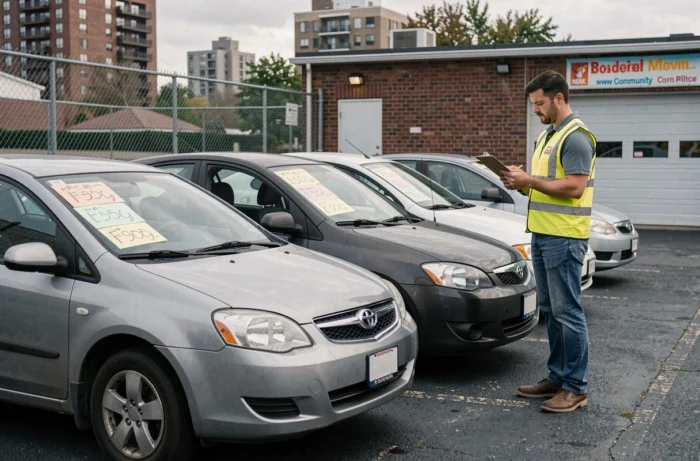
Buying, even through solidarity, is not always the appropriate response. The Ministry of Ecological Transition has launched a call for expressions of interest regarding the opening of professional fleets to car sharing. This initiative allows vehicles to be pooled among several users, reducing the individual cost of mobility.
Professional fleet car sharing can complement or replace solidarity purchasing for those whose travel needs are occasional. An employee in integration who only needs a vehicle three days a week pays less through car sharing than by bearing all the costs of a personal vehicle.
Solidarity garage or car sharing: selection criteria
- Frequency of use: daily use justifies purchase, occasional use points towards car sharing.
- Overall monthly budget: solidarity purchasing involves fixed costs (insurance, maintenance), while car sharing smooths costs over actual usage.
- Geographical area: in rural areas, car sharing is rarely available, making solidarity purchasing often necessary.
The choice between these two options depends on a simple calculation: compare the total monthly cost of ownership (amortized purchase, insurance, fuel, maintenance) with the monthly cost of a sharing service, when it exists locally. In rural areas, the solidarity garage remains the most direct mobility lever for low-income households guided by a social prescriber.