Decor trends refer to the aesthetic and material orientations that shape interior design choices over a season or a year. In 2026, these trends are organized around a guiding principle: qualitative sobriety, where each element of the decor is chosen for its durability and tactile comfort rather than for its immediate visual effect.
Quiet luxury applied to interior decor: what the term encompasses
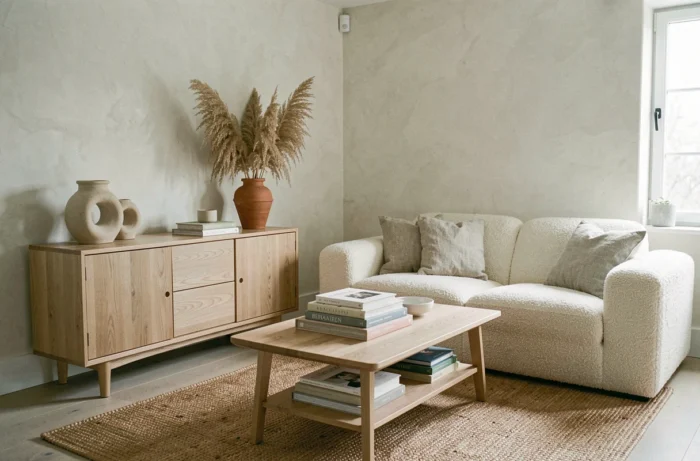
Quiet luxury in decoration reflects a shift towards warm and minimalist interiors. The concept, originating from fashion, applies to living spaces by refocusing on the quality of materials and the coherence of textures rather than the accumulation of decorative objects.
In practical terms, this means favoring a well-crafted piece of furniture over three interchangeable accessories. The logic is that of “buy less, buy better,” which is influencing European decor projects this year.
This approach also changes the way a living room or bedroom is composed. Surfaces remain clear, storage is integrated, and natural light takes precedence over decorative lighting. To explore all the decor universes on Cherry Déco, this logic of sobriety is reflected in the selections of furniture and accessories offered.
Quiet luxury is not limited to a cold minimalist style. It is distinguished by the presence of warm textures (thick linen, matte velvet, boucle wool) that bring a sensory dimension absent from classic minimalism.
Earthy color palettes and mineral shades for the living room
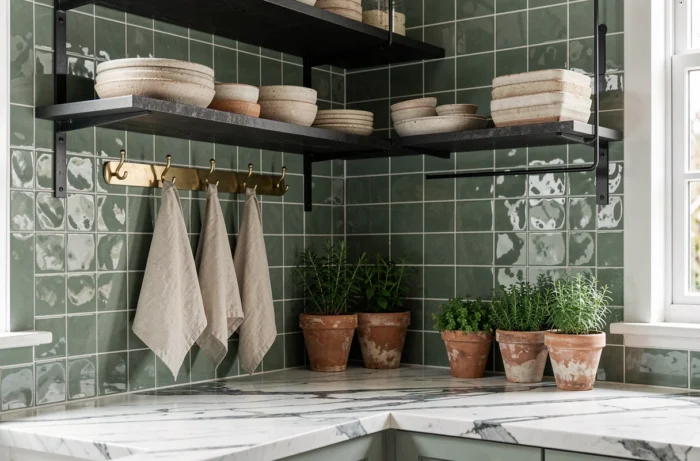
Cool grays and clinical whites that dominated interiors until 2023-2024 give way to earthy and mineral palettes. Soft terracotta, clay tones, warm browns, and deep greens form the chromatic base of living rooms and living spaces.
Pantone has identified “Cloud Dancer” as the structuring color for 2026. This luminous white, far from classic optical white, serves as an enveloping base. Its role is to soften contrasts with earthy tones without creating a cold break.
Combining shades without disrupting the space
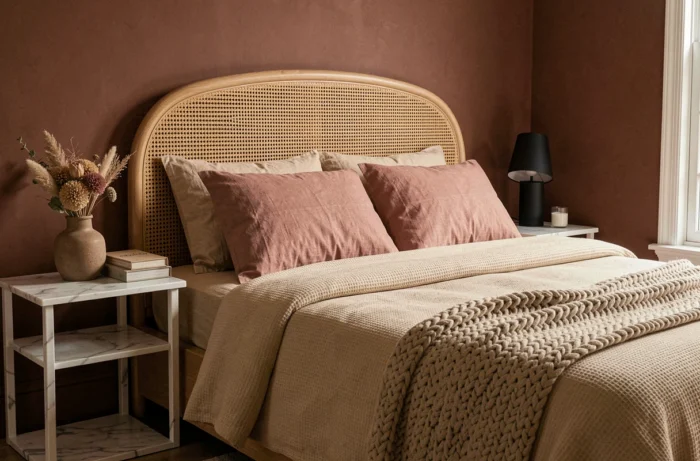
The principle is to work with closely related values. A wall in soft terracotta pairs with a sofa in a slightly lighter brown, while textiles (cushions, curtains) incorporate a deep green as an accent.
- The distribution rule works on three levels: a dominant neutral shade (light clay or Cloud Dancer) on large surfaces, a warm secondary color (terracotta, brown) on the main furniture, and a plant or mineral accent on accessories.
- Matte finishes should be favored on walls to enhance the mineral effect, as satin surfaces reflect light and disrupt the sought-after tactile coherence.
- Gold or copper metals, once omnipresent, become more discreet in favor of aged brass or matte black iron, in line with the overall sobriety.
Natural materials and tactile comfort: wood, velvet, and raw fibers
The choice of materials forms the technical foundation of these decor trends. Wood remains the dominant material, but its treatment is evolving. Very light Scandinavian finishes are declining in favor of medium-toned woods, slightly patinated, which add depth without darkening the room.
Velvet, already present in previous years, is here to stay. Its 2026 version is matte and dense, far from shiny velvets with reflections. It can be found on living room seating, headboards, and some accent cushions.
Layers of fibers and textures
The layering of textures replaces the play of colors as the main decorative lever. A jute rug under a raw wood table, a boucle wool throw on a linen sofa: each layer adds a different sensation to the touch and the eye.
Rattan and caning maintain their place, primarily on lighting fixtures and small accent furniture. Thick, raw, or slightly wrinkled linen dominates curtains and household linens. These materials share a common point: they age without losing their visual quality, which aligns with the logic of sustainability.
Organic shapes and plant motifs in wall decoration
Strict geometric lines give way to organic and rounded shapes. Mirrors with irregular edges, coffee tables with curved sides, asymmetrical vases: these elements soften the rigidity of the rectangular spaces that make up most interiors.
This trend is not solely aesthetic. Rounded shapes modify visual flow in a room. The eye glides over curves instead of bumping into angles, contributing to the sought-after sensation of calm.
The plant motif without excess
Plant motifs are returning in wall decoration (wallpapers, textile prints), but in stylized and tone-on-tone versions. Large, highly contrasted tropical leaves are giving way to fine, almost monochromatic botanical patterns that add depth without visually saturating the room.
- One patterned wall per room is enough to create a focal point without overload.
- Plant motifs work better on neutral backgrounds (Cloud Dancer, natural linen) than on already saturated shades.
- As an alternative to wallpaper, slatted wood panels provide an abstract plant relief suitable for small spaces.
Modularity of furniture: adapting decor to the actual use of spaces
Modular furniture responds to a concrete constraint: the versatility of rooms. A living room that also serves as an office, a bedroom that accommodates a reading nook, these mixed configurations require furniture that can adapt.
Modular sofas are the centerpiece of this trend. Composed of independent modules, they can be reconfigured according to the number of people present or the activity taking place. Open shelves replace closed bookshelves to serve both as storage and space separation.
Nesting side tables and stackable seating complete this approach. The idea is not to own fewer pieces of furniture, but to have furniture that serves multiple functions without compromising decorative coherence.
The common thread of these decor trends can be summed up in one word: intentionality. Every choice of color, material, or shape is part of a search for overall coherence rather than the accumulation of individually appealing pieces. An interior where each element has been chosen for its function and its relationship to others produces a more refined result than a collection of trends applied separately.