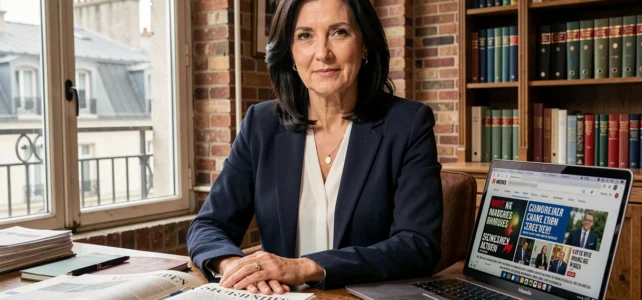
Isabelle Lasserre is a French journalist specializing in geopolitics, born in 1966. Associated with Le Figaro for many years, she covers diplomatic, strategic, and military issues. Her name frequently appears on television panels and Radio France broadcasts, where she analyzes international crises.
Isabelle Lasserre at Le Figaro: from diplomatic fieldwork to editorial leadership
Isabelle Lasserre’s journey within Le Figaro illustrates a progression through specialization. Long identified as a diplomatic correspondent, she has covered major crises over the past two decades, from tensions between NATO and Moscow to conflicts in Ukraine.
Recent sources indicate that she now holds the position of deputy editor-in-chief, or more precisely, deputy head of the Foreign Affairs section of the newspaper. This rise in editorial responsibility reflects internal recognition of her expertise. She no longer merely signs analyses: she participates in coverage decisions and the direction of international topic treatment.
In parallel, her activities extend beyond Le Figaro. In 2026, she authored a long interview in the journal Politique Internationale (issue 192), on the theme “The West and Its Enemies.” This type of collaboration with specialized journals places her at the intersection of daily journalism and deep geopolitical reflection. To delve deeper into Isabelle Lasserre’s biography and family, several resources detail the significant milestones of her career.
Isabelle Lasserre’s family and private life: what filters through despite discretion
Research on Isabelle Lasserre’s family encounters a notable fact: she protects her personal sphere with a rare consistency in the media world. No public interview provides details about her partner, children, or family life.
This discretion contrasts with the exposure she enjoys. Regular invitations to high-profile shows, such as C à vous or Radio France morning programs, could have encouraged personal revelations. This is not the case. The few elements circulating online come from third-party sites that compile snippets without primary sources.
The choice to strictly separate public and private life is not trivial for a journalist covering sensitive issues. Diplomatic correspondents dealing with Russia, Ukraine, or the Middle East face pressures. Maintaining a boundary between professional and personal life is both a principle and a precaution.
Isabelle Lasserre and Wikipedia: an absence that raises questions
A surprising fact accompanies Isabelle Lasserre’s notoriety: there is no French Wikipedia biographical page dedicated to her. Only a very brief Wikidata entry exists in her name.
For a journalist so established in the French media landscape, this gap is unusual. Peers with comparable backgrounds have detailed pages. Several hypotheses may explain this absence:
- Wikipedia’s notability criteria require secondary sources focused on the person, not just their work. However, press articles mention Isabelle Lasserre for her analyses, rarely for herself.
- The French Wikipedia community regularly deletes biographical drafts of journalists deemed insufficiently sourced, creating a cycle where personal discretion prevents the creation of the page.
- Isabelle Lasserre herself may not wish for this encyclopedic visibility, logically consistent with her withdrawal from private life.
This absence paradoxically fuels public curiosity. Searches for “Isabelle Lasserre Wikipedia” rank among the queries associated with her name, evidence that internet users seek a biographical summary that does not exist on the reference platform.
Books and positions: geopolitics as a guiding thread
Isabelle Lasserre is also an author. Her works focus on international power dynamics, with a marked interest in Russia and European defense issues. Her editorial work extends her daily analyses, providing a depth that the article format does not always allow.
What characterizes her production is a desire to make technical subjects accessible. Issues of nuclear deterrence, NATO’s strategic posture, or the reshaping of alliances are addressed with a pedagogical concern. This approach leads her to be sought after by both mainstream media and specialized circles.
Her media presence covers a wide spectrum:
- Television appearances on continuous news channels, especially during peaks of international crisis
- Participation in debate shows like 24h Pujadas on LCI, where she comments on diplomatic news
- Columns and analyses in Le Figaro, with a regularity that makes her one of the most recognized voices in the newspaper on international topics
The transition from correspondent to deputy editor-in-chief has not diminished her presence in the media landscape. She combines editorial responsibility and public visibility, a rare combination in the French daily press.
Isabelle Lasserre’s trajectory remains marked by this contrast between strong professional exposure and an assumed personal opacity. It is precisely this discrepancy that generates online searches about her, without the answer ever being complete.